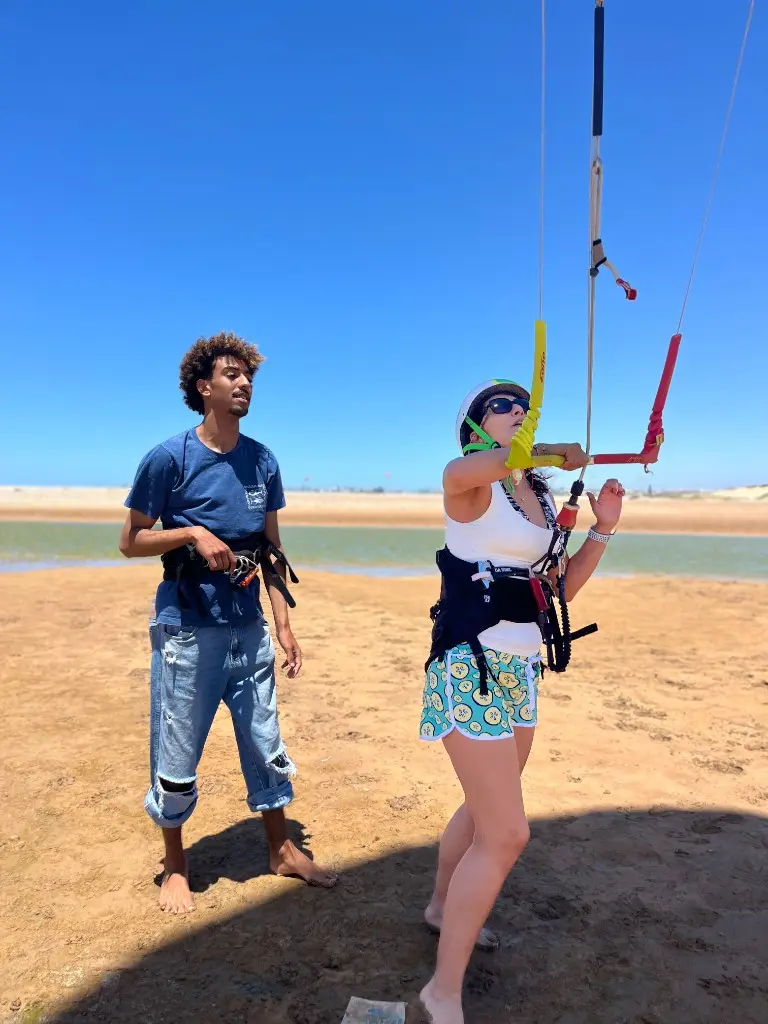
Learn beginner kitesurfing: complete guide 2026
TL;DR
How to learn kitesurfing when you start? IKO progress, equipment, safety and spots. Expert guide for your first sessions — book your course in Essaouira.
How to learn kitesurfing: complete guide for beginners
Quick definition: Learning beginner kitesurfing involves mastering safety, piloting the kite in the flight window, body dragging then water starting on a board, ideally with an IKO certified instructor. In 6 to 12 supervised hours, most students navigate their first meters on the water.
Introduction
Do you dream of gliding across the water propelled by the power of the wind, feeling the pull of the kite and experiencing the adrenaline of a successful water start? Learning beginner kitesurfing is more accessible than it seems — provided you follow a structured progression according to IKO (International Kiteboarding Organization) standards, choose the right equipment and respect safety rules at sea.
Whether you are in France, Morocco, Belgium or French-speaking Canada, this guide explains how to start kitesurfing step by step: physical preparation, choice of spot, fundamental techniques, mistakes to avoid and resources to progress quickly. According to IKO experts and experienced instructors, the key is not brute force, but regularity, reading the wind and quality supervision.
At Essaouira Surf Camp School, we train hundreds of beginners each year on Essaouira Bay — a protected lagoon enjoying more than 300 days of wind per year, ideal for your first sessions. Our school is IKO certified and offers complete progression from kite flying to the first turns. This guide is based on this field experience, combined with IKO international standards.
Why learn kitesurfing with an IKO certified instructor?
The direct answer: a supervised kitesurfing lesson reduces risks, speeds up progression and teaches you safety procedures from the first session.
The advantages of a kitesurfing school vs self-learning
Practicing alone without training exposes you to major dangers: loss of control of the kite, involuntary power loop, collisions with other riders or the edge. An IKO instructor places you in a suitable spot, far from obstacles, with controlled equipment and clear emergency procedures.
Professionals recommend at least 6 to 12 hours of lessons before practicing independently. Here's what a standard 3-hour course typically includes:
- Safety briefing: wind, tide, practice area, quick release systems
- Theory: flight window, cardinal points, danger zones
- Flying the kite on the sand (trainer kite or complete kite)
- Body drag at sea (upwind and downwind)
- Water start and first meters on board
- Debriefing and personalized advice
Where to learn kitesurfing: criteria for a good beginner spot
| Criterion | Ideal beginner spot | Spot to avoid |
|---|---|---|
| Water | Flat or slightly choppy | Big swell, violent shorebreak |
| Background | Sand, gradual depth | Rocks, reefs, drop-offs |
| Wind | Regular trade wind 15–25 knots | Unpredictable gusts > 30 knots |
| Obstacles | Clear area, wide beach | Walk, rocks, bathers |
| Crowd | Few experienced riders | Saturated spot without rules |
| Access | School on site, emergency services nearby | Isolated spot without assistance |
Essaouira (Morocco), Leucate — La Franqui, Tarifa (Spain) or Dakhla (Morocco) are among the most recommended destinations to start kitesurfing with complete peace of mind. Essaouira Bay combines flat water in the morning, trade winds in the afternoon and an IKO school directly on the beach.
The key steps to learning beginner kitesurfing (IKO progression)
Here's how to structure your progress from the very first day until your first turns in autonomous navigation.
Step 1: Prepare your body and understand the equipment
Before even hitting the water, check that you can swim comfortably in the sea (minimum 50 meters). Hardware side to start:
- Kite (kite) 9 to 12 m² depending on wind and weight — often loaned by the school
- Bar with lines and safety system (chicken loop, quick release, leash)
- Harness (waist harness or seat harness depending on preference)
- Board twin-tip or directional depending on objective (freestyle vs wave)
- Wetsuit 3/2 mm or shorty depending on season and water temperature
Serious schools include kite, bar, harness and board in the course price - check before booking on our kitesurf page.
Step 2: Master the flight window and flying on sand
The wind window is the aerial area where the kite generates power. Understanding the neutral (12 p.m.), power (10 a.m.–2 p.m.) and danger (window edge) zones is fundamental before entering the sea.
On the sand, learn to:
- Take off and land the kite safely (assisted launch and landing)
- Ride in figure-of-eight to feel traction
- Use the bar: pull = power, release = depower
- Activate quick release in simulation (muscle memory)
Repeat 30 to 60 minutes of riding on the sand before the body drag. According to IKO instructors, proper piloting on the ground halves the learning time at sea. To find out more, consult our guide kitesurf kite piloting.
Step 3: Body drag — moving at sea without a board
Body drag consists of letting yourself be towed by the kite while swimming or in a prone position. Two essential variations:
- Body drag downwind: the wind pushes you towards the edge - recovery of lost board
- Body drag upwind: upwind in side position, kite in 10 a.m. or 2 p.m.
This is the step that secures your practice: knowing how to return to the edge without a board. Allow 2 to 4 sessions dedicated to body drag before the water start. Read our detailed article on body dragging kitesurf.
Step 4: Water start — your first meters on the board
The water start is the technique that takes you from water to gliding. Typical sequence:
- Sitting position, board perpendicular to the wind, kite in 12 hours
- Dip the board, orient the front foot towards the wind
- Pull the bar in 10 hours or 14 hours to generate traction
- Stand up by pushing on your legs, looking towards the edge
- Stabilize the position, depower slightly to control the speed
Most beginners successfully complete their first water start between the 6th and 12th hours of lessons. Our guide waterstart kitesurf details each phase.
Stage 5: Stable navigation and first turns
Once the water start has been mastered, work on upwind sailing (upwind) and transitions (tack and jibe). Objective: maintain 100 meters of stable gliding before learning the turns. See our article virages kitesurf jibe tack.
What equipment to start kitesurfing? Comparison of kites and boards
The definition of good beginner equipment: stable kite with good depower, wide and tolerant board, comfortable harness.
| Equipment | Beginner size | Advantages | Disadvantages |
|---|---|---|---|
| Freeride kite | 9–12 m² | Stable, good depower, easy restart | Less efficient in waves |
| C-kite kite | 8–10 m² | Direct feeling, pop for freestyle | Less margin for error |
| Twin-tip | 140-160cm | Versatile, symmetrical, easy | Less suitable for big waves |
| Directional | 145-165cm | Comfort in chop, wave surfing | Asymmetrical, different transitions |
| Seat harness | Adjustable size | Stable for beginners, lumbar comfort | Less mobility than a waist |
Recognized brands for learning: Duotone, Cabrinha, North, F-One, Slingshot and Ozone. Pros recommend renting or borrowing through the school before buying — the equipment evolves quickly with your level.
Practical advice: your 4-week plan
Step 1 — Week 1: 2 supervised lessons (sand driving + body drag). Objective: kite control, body drag upwind 50 m.
Step 2 — Week 2: 2 classes (body drag + water start). Objective: 3 to 5 successful water starts per session.
Step 3 — Week 3: 2 lessons (water start + navigation). Objective: 200 m of continuous gliding, speed control.
Step 4 — Week 4: 1 lesson + 1 independent supervised session (if the instructor validates). Objective: basic upwind, first tack. Between sessions, fitness kitesurf helps enormously: core, squats, swimming and hamstring stretches. Physical preparation targets the core, legs and shoulders – areas used by the harness and the bar.
Common mistakes kitesurfing beginners make
Here are the 7 most common mistakes when learning kitesurfing:
- Skip the IKO steps — water start without controlled body drag = danger in case of loss of board
- Pilot the kite in a danger zone — power loop, violent fall
- Choose a spot that is too windy — frustration and increased risk (> 25 knots for a beginner)
- Ignore the quick release — never practice without knowing your safety systems
- Looking at the kite instead of at the horizon — loss of balance and poor orientation
- Board too small — water start impossible, excessive fatigue
- Give up after 2 sessions — kitesurfing progression requires 10 to 20 hours minimum
According to IKO professionals, consistency beats talent: 1 session per week minimum for 2 months transforms a beginner into an independent rider in moderate conditions.
Essaouira: the ideal destination to learn kitesurfing
Why Essaouira Bay?
Essaouira Bay offers a rare combination for beginners:
- More than 300 days of wind per year — regular trade winds from April to October
- Flat water in the morning in the lagoon — perfect for piloting and water starting
- Protected bay — no violent shorebreak, progressive depth
- IKO school on site — Essaouira Surf Camp School, recent equipment, multilingual instructors
- Surf + kitesurf combination — surf in the morning, kitesurf in the afternoon
Comparison of beginner kitesurfing spots
| Spot | Wind (days/year) | Water | Beginner level | IKO School |
|---|---|---|---|---|
| Essaouira | 300+ | Light plate / chop | Great | Yes |
| Dakhla | 280+ | Lagoon + ocean | Good (lagoon) | Yes |
| Leucate | 250+ | Plate | Great | Yes |
| Tarifa | 300+ | Chop, swell | Medium (strong wind) | Yes |
Kitesurf weather tools
- Windguru and Windy for direction, force and gusts
- Kiteforum for spot returns and local conditions
- Validation of the course 24 hours in advance via the school — safety above all
FAQ
Related Posts
Watersports Guide: Surf, Kitesurf & Wing Foil Lessons in Essaouira 2026
Complete Essaouira watersports guide — surf mornings, kite & wing afternoons, IKO/ISA lesson pathways, official prices from €30, seasonal calendar and what to pack for lessons.
Packing List for a 6-Day Surf Camp in Essaouira 2026 | Complete Checklist
What to pack for a 6-day surf camp in Essaouira — wetsuit extras, layering for Atlantic wind, toiletries, electronics and MAD cash tips for Morocco's Wind City.
Guide to Surf Courses in Essaouira 2026 | Formats, Prices & Spots
Complete guide to surf courses in Essaouira — group, semi-private and private lessons from €30, multi-day packs, ISA coaching, lesson roadmap, Sidi Kaouki safaris and booking tips.
Kitesurf Reviews — Essaouira Surf Camp School
Real kitesurf guest experiences in Essaouira, Morocco — IKO & ISA certified school, 5/5 Google rating.
Kitesurf FAQ Essaouira — Questions & Answers
Everything about kitesurf in Essaouira: prices, levels, gear, weather, booking and Morocco spots.