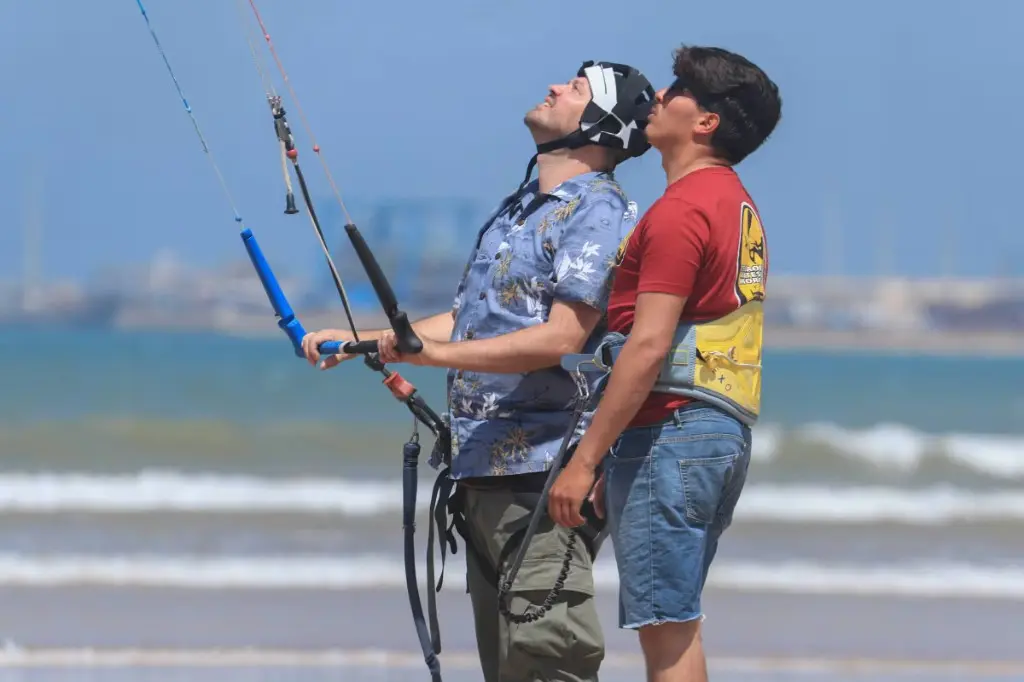
Body dragging kitesurf: complete technique IKO 2026
TL;DR
Master body drag in kitesurfing: downwind, upwind, board recovery and safety. IKO step-by-step guide — course in Essaouira, protected bay, 300+ days of wind.
Body dragging kitesurf: mastering towed movement at sea
Quick definition: Body dragging kitesurfing consists of moving at sea propelled by the traction of the kite, without a board — in a ventral (downwind) or lateral (upwind) position. This is the essential IKO step between riding on sand and water starting, and the skill that saves you if you lose your board at sea.
Introduction
You have mastered flying the kite on the sand. And now ? Before getting on the board, you must learn how to move around the sea pulled by the kite — this is body drag. This stage sometimes frightens beginners, yet it is paradoxically one of the most educational and reassuring phases of IKO progression.
Body drag teaches you three essential things: feeling the pull of the kite in the water, returning to the starting point without a board (body drag upwind), and recovering a lost board (body drag downwind + board retrieval). Without these skills, you should never kitesurf independently.
This guide details each variation of body dragging kitesurf: techniques, errors, progressive exercises and ideal conditions. Essaouira Surf Camp School, IKO school on Essaouira Bay (300+ days of wind per year), devotes 2 to 4 sessions to body drag before any water start. This content reflects our field methodology.
Prerequisites: mastered kite piloting — see our guide kitesurf kite piloting.
Why body drag is essential
The direct answer: body drag is the kitesurfer's life insurance. Losing your board at sea without knowing how to get back to shore is a dangerous situation. The body drag upwind is the only upwind technique without a board.
Place in IKO progression
| IKO level | Skill | Body drag |
|---|---|---|
| Discovery | Sand piloting | — |
| Intermediate | Body drag downwind + upwind | Mandatory |
| Independent | Water start + navigation | Validated if body drag OK |
| Advanced | Turns, jumps | Body drag = acquired |
What body drag teaches you
- Traction at sea: the kite reacts differently once the lines are in the water
- One-hand steering: one hand on the bar, the other free to swim or grab the board
- Panic management: stay calm when the wind blows you away
- Material recovery: find and bring back your board
- Physical condition: swimming, endurance, confidence in deep water
Body drag downwind: technique and use
The body drag downwind takes you towards the edge, in the direction of the wind. This is the basic technique and the one used to recover a lost board.
Position and steering
- Enter deep water (minimum chest height), kite launched
- Position ventral or slightly on the side, head facing the edge
- Kite in 12 p.m., then controlled power stroke around 10 a.m. or 2 p.m.
- One hand on the bar (front hand), the other free to swim if necessary
- Let yourself be pulled — don’t fight the pull, guide it
Speed and control
- Accelerate: more pronounced power stroke, kite lower in the window
- Slow down: depower (push bar), kite goes up in 12 hours
- Stop: kite in 12 hours, maximum depower
Board retrieval
Classic scenario: you lost your board at sea.
- Body drag downwind towards the board
- Spot the board — bright colors, visible rigging
- Approach from the rear or side
- Grasp the board leash or handle with one hand
- Stabilize the kite in 12 hours, board in secure position
- Perform a body drag upwind back to your starting point
IKO exercise: the instructor throws the board, you must recover it in less than 3 minutes.
Body drag upwind: going upwind without a board
Body drag upwind is the most demanding technique in body dragging kitesurfing. It allows you to return to your starting point – or to the edge – by going upwind.
Upwind body drag mechanics
Unlike downwind, upwind requires:
- Kite stabilized in 10 hours (if right wind) or 14 hours (if left wind)
- Body in lateral position: shoulder forward, hips slightly raised
- Legs straight with alternate kick or surf position
- Body oriented at 30–45° relative to wind direction
- Moderate traction — no aggressive power stroke
Errors that prevent upwind
| Error | Consequence | Correction |
|---|---|---|
| Kite flying in 12 hours | Downwind drift | Stabilize in 10 hours or 14 hours |
| Excessive power stroke | Too much speed, loss of angle | Moderate traction, frequent depower |
| Ventral body | Unable to go up | Move to side position |
| Looking towards the kite | Wrong orientation | Looking towards the upwind target |
| Wind too weak (< 12 knots) | Insufficient traction | Choose a windier day or bigger kite |
Progressive exercise
- 50 m upwind: first body drag upwind session objective
- 100 m upwind: intermediate IKO validation
- Upwind + board retrieval: recover board then go back up — autonomy simulation
- Upwind one-hand + plank: hold plank and bar — water start preparation
Body drag with board: preparation for the water start
Before the water start, the IKO instructor has you practice body drag with board:
Technical
- Board held with one hand (handle or rail upwind)
- Steer with the other hand, kite in 12 hours
- Body drag upwind while dragging the board alongside
- Alternating hands to simulate the water start position
Educational objective
- Feel the resistance of the board in the water
- Coordinate kite piloting and board management
- Develop the lateral balance necessary for water starting
Then continue with our guide waterstart kitesurf once the body drag has been validated.
Safety and equipment for body drag
Mandatory equipment
- Helmet: skull protection during falls during the learning phase
- Impact vest: thorax protection and light buoyancy
- Wetsuit: UV protection, warmth, slight buoyancy
- Quick release tested: before each entry into the sea
IKO safety rules
- Never do body drag alone without instructor validation
- Clear spot: no rocks, swimmers, boats
- Wind 12–25 knots for beginners — above that, reduce kite size
- Buddy system: another rider or instructor observes from the edge
- Know the depth — no body drag in water that is too low (risk of shock)
What to do if there is a problem
- Loss of control of the kite: immediate quick release, swim towards the edge
- Cramp or fatigue: depower, floating on the back, signal to the monitor
- Kite fallen into the sea: do not panic, swim towards the kite, water relaunch if trained
Common mistakes in body dragging kitesurfing
- Switch to water start without controlled upwind — dangerous situation in autonomy
- Body drag in too strong wind (> 28 knots beginner) — loss of control
- Let go of the bar to swim — uncontrolled kite; always one hand on the bar
- Neglecting plank recovery — underrated vital skill
- High current spot — unpredictable drift, increased fatigue
- Cutsuit too thick — restriction of movement in body drag
- Session too long without break — fatigue = piloting errors
Body drag in Essaouira: optimal conditions
The bay of Essaouira is recognized worldwide for learning kitesurfing, and body drag is the showcase:
Benefits of the bay
- Flat water in the morning: lagoon without chop — comfortable body drag
- Steady trade wind: 15–22 knots, stable direction — predictable traction
- More than 300 days of wind per year: easy stay planning
- Progressive depth: from the sandy edge to deep water in a few meters
- IKO school on site: Essaouira Surf Camp School, instructor-student radio communication
Body drag type planning (3 sessions)
| Session | Content | Objective |
|---|---|---|
| Session 1 | Body drag downwind 100 m | Traction comfort at sea |
| Session 2 | Body drag upwind 50 m + board retrieval | Upwind |
| Session 3 | Upwind 100 m + body drag with board | IKO validation → water start |
Book on our kitesurf page. Also check out learn beginner kitesurf for the overview.
FAQ
Related Posts
Watersports Guide: Surf, Kitesurf & Wing Foil Lessons in Essaouira 2026
Complete Essaouira watersports guide — surf mornings, kite & wing afternoons, IKO/ISA lesson pathways, official prices from €30, seasonal calendar and what to pack for lessons.
Packing List for a 6-Day Surf Camp in Essaouira 2026 | Complete Checklist
What to pack for a 6-day surf camp in Essaouira — wetsuit extras, layering for Atlantic wind, toiletries, electronics and MAD cash tips for Morocco's Wind City.
Guide to Surf Courses in Essaouira 2026 | Formats, Prices & Spots
Complete guide to surf courses in Essaouira — group, semi-private and private lessons from €30, multi-day packs, ISA coaching, lesson roadmap, Sidi Kaouki safaris and booking tips.
Kitesurf Reviews — Essaouira Surf Camp School
Real kitesurf guest experiences in Essaouira, Morocco — IKO & ISA certified school, 5/5 Google rating.
Kitesurf FAQ Essaouira — Questions & Answers
Everything about kitesurf in Essaouira: prices, levels, gear, weather, booking and Morocco spots.