Kite flying kitesurfing: techniques and progression 2026
TL;DR
Master kite flying in kitesurfing: flight window, figure-of-eight, depower and safety. Complete IKO guide for beginners and intermediates in Essaouira.
Kitesurfing kite flying: mastering kite control
Quick definition: Kitesurfing kite flying consists of controlling the traction and direction of the kite via the bar and lines, respecting the flight window. This is the fundamental skill before body drag and water start — 80% of kitesurfing safety is based on controlled piloting.
Introduction
Before you slide on the water, before you even touch a board, you must learn how to fly the kite. This is the basis of all kitesurfing: without kite control, no body drag, no water start, no navigation. However, many beginners underestimate this step and want to move on too quickly.
This guide details how to master kiteboarding: anatomy of the equipment, flight window, exercises on the sand, techniques at sea and mistakes to avoid. Whether you train on a 2 m² trainer kite or on a 12 m² freeride kite, the principles remain the same.
At Essaouira Surf Camp School, an IKO certified school, we systematically devote the first or second session to piloting on the bay beach — benefiting from more than 300 days of wind per year and an open space perfect for learning. This guide is based on our field experience and IKO standards.
If you are completely new to it, start by reading our guide learn beginner kitesurf for the overview of progression.
Anatomy of the kite and the bar
The direct answer: understanding each element of the equipment allows you to drive consciously and activate the right safety systems at the right time.
The kite
The kite consists of:
- Sail (canopy): surface capturing the wind, available in C-kite, bow, delta or hybrid shapes
- Leading edge: structural inflatable tube, inflated via pump
- Trailing edge: rear of the sail, depower zone
- Lines: 4 or 5 lines connecting the kite to the bar (front lines, back lines)
- Struts: transverse reinforcements stabilizing the sail
The bar and the harness
- Bar: control bar with depower adjust, chicken loop, quick release
- Chicken loop: loop attached to the harness hook — main connection point
- Quick release (QR): emergency trigger releasing traction — to be tested before each session
- Leash: safety clip connecting bar and harness (short or long leash depending on configuration)
- Harness: waist harness (belt) or seat harness (breeches) — transfer of traction to the body
| Element | Function | Common error |
|---|---|---|
| Pulled bar | Power — maximum traction | Shoot in danger zone |
| Push bar | Depower — reduced traction | Forget about burst depower |
| Quick release | Total emergency shutdown | Never tested it |
| Trim depower | Fine power adjustment | Incorrectly set before session |
The flight window: foundation of piloting
Here is the essential map that every rider must engrave in their memory.
Flight window areas
Imagine a semi-circle in front of you, with the wind at your back:
- Neutral zone (12 h / zenith): kite overhead — minimum power, rest and safety position
- Power zone (10 a.m. – 2 p.m.): progressive traction — navigation and water start zone
- Power zone (lower center, 9 a.m. – 3 p.m. near the ground): maximum traction — controlled takeoff zone, never parking
- Window edges (waterside): dangerous area — risk of power loop and violent fall
IKO golden rule
Never leave the kite parked on the edge of a window. Always make it move: figure-of-eight, controlled up-down. A stationary kite at the edge of a window can switch into a power loop without warning.
Mental exercise: the time dial
- 12 p.m. = zenith, neutral
- 10 a.m. / 2 p.m. = navigation, body drag, water start
- 9 a.m. / 3 p.m. = power zone — quick passage only
- 8 a.m. / 4 p.m. and beyond = danger — absolutely avoid
Driving exercises on the sand
Step by step, here is the progression recommended by the IKO instructors at Essaouira Surf Camp School.
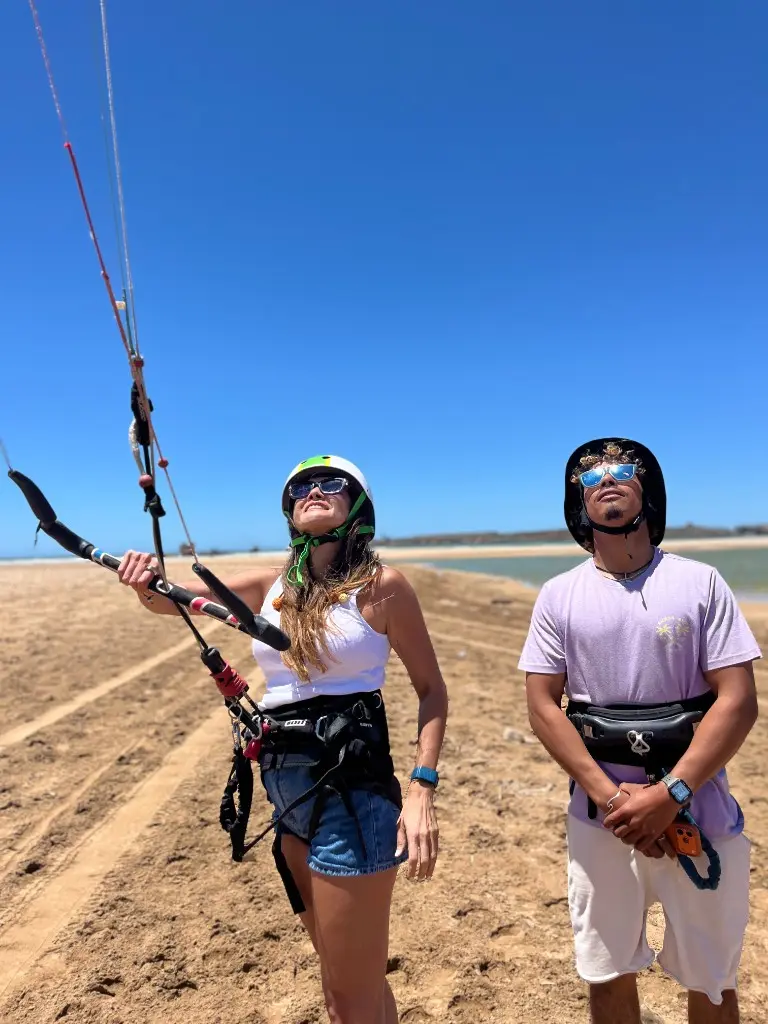
Phase 1: Trainer kite (2–3 m²) — 30 to 60 minutes
Ideal for the first session or supervised autonomy:
- Deployment of the trainer without bar (2 lines) or with simplified bar
- Figure-of-eight slow on the ground, kite at shoulder height
- Feel the traction in the 10 a.m. and 2 p.m. zone without leaving the ground
- Simulate depower: push bar, return in 12 hours
Phase 2: Complete kite on the sand — 1 to 2 hours
With inflated kite and complete bar:
- Assisted launch: takeoff with help from the instructor or buddy system
- Static piloting: hold the kite for 12 hours 30 seconds without moving
- Dynamic figure-of-eight: chain 10 a.m. → 12 p.m. → 2 p.m. → 12 p.m. in a smooth loop
- Controlled power stroke: descent from 12 o'clock around 10 o'clock then ascent — feel the traction without being pulled
- Assisted landing: place the kite safely on the sand
Phase 3: One-hand piloting and body position
- Driving with one hand (front hand on bar) — body drag preparation
- Walk sideways while piloting — movement simulation
- Sit down then get up without letting go of the bar — water start preparation
Repeat each phase until automatic. According to the IKO, 2 hours of sand piloting minimum before the body drag at sea.
Pilotage at sea: body drag integration
Once sand flying has been mastered, the kite can be flown at sea without a board — the body drag. The management remains the same, but the environment changes:
Body drag downwind
- Kite flying in 12 hours, then power stroke around 10 a.m. or 2 p.m.
- Prone or side position, one hand on bar
- The wind pushes you towards the edge — useful for retrieving a lost board
Body drag upwind
- Kite stabilized in 10 hours or 14 hours (wind side)
- Body in lateral position, front leg slightly bent
- Progression at 30–45° to the wind — return to the starting point
Upwind piloting requires controlled window edge stability without entering the power zone. This is the ultimate test of beginner piloting. Go deeper with our body dragging kitesurf guide.
Advanced kite flying techniques
For riders who have validated water start and basic navigation:
One-handed control
Essential for transitions, jibe and board recovery. Front hand on the center of the bar, body turned, kite stable at 12 o'clock or slightly offset.
Reverse piloting (switch)
Kite flown “in reverse” after a jibe — same flight window logic, reversed sensations. Progression towards riding switch.
Controlled loop and kiteloop
Reserved for experienced riders: complete loop of the kite generating extreme power. Never attempt without supervision and a clear spot.
Deep water relaunch
Kite fallen at sea: control of the back lines to orient the leading edge, then power stroke controlled to take off again. Essential technique in autonomy.
Common errors in kite flying
- Look at the kite — look at the horizon, the kite is in peripheral vision
- Bar pulled permanently — keep 10–20 cm of depower while sailing
- Windowside parking — always move the kite
- Launch alone without experience — always launch assisted until monitor validation
- Quick release never tested — test QR and reset before each session
- Steering arms outstretched — elbows slightly bent, absorption of gusts
- Ignore bursts — preemptive depower before the burst, not after
Training and progression: 2-week plan
| Day | Exercise | Duration | Objective |
|---|---|---|---|
| J1 | Trainer kite figure-of-eight | 45 mins | Basic fluidity |
| J2 | Sand kite — launch/land | 1 hour | Takeoff safety |
| J3 | Controlled power stroke | 1 hour | Feel traction without falling |
| J4 | Body drag downwind | 2 a.m. | 100m without panic |
| J5 | Upwind Drag Bodysuit | 2 a.m. | Return to starting point |
| J6 | Piloting + one-hand review | 1 hour | Water start preparation |
| J7 | Rest or flight window theory | — | Consolidation |
In Essaouira, Essaouira Surf Camp School structures this progression over 3 to 5 sessions with regular trade winds — ideal conditions for effective kiteboarding.
Essaouira: perfect conditions for driving
Essaouira Bay combines:
- Trade wind 15–25 knots, stable northeast direction
- More than 300 windy days per year
- Wide and clear beach for sand piloting
- Flat water lagoon in the morning for body drag without chop
- IKO School with recent equipment (Duotone, Cabrinha, North)
Morning (9 a.m.–12 p.m.): flat water, wind 12–18 knots — ideal for beginner piloting and body dragging. In the afternoon (2 p.m.–6 p.m.): wind 18–25 knots — water start progression and navigation.
Book a piloting session on our kitesurf page.
FAQ
Related Posts
Watersports Guide: Surf, Kitesurf & Wing Foil Lessons in Essaouira 2026
Complete Essaouira watersports guide — surf mornings, kite & wing afternoons, IKO/ISA lesson pathways, official prices from €30, seasonal calendar and what to pack for lessons.
Packing List for a 6-Day Surf Camp in Essaouira 2026 | Complete Checklist
What to pack for a 6-day surf camp in Essaouira — wetsuit extras, layering for Atlantic wind, toiletries, electronics and MAD cash tips for Morocco's Wind City.
Guide to Surf Courses in Essaouira 2026 | Formats, Prices & Spots
Complete guide to surf courses in Essaouira — group, semi-private and private lessons from €30, multi-day packs, ISA coaching, lesson roadmap, Sidi Kaouki safaris and booking tips.
Kitesurf Reviews — Essaouira Surf Camp School
Real kitesurf guest experiences in Essaouira, Morocco — IKO & ISA certified school, 5/5 Google rating.
Kitesurf FAQ Essaouira — Questions & Answers
Everything about kitesurf in Essaouira: prices, levels, gear, weather, booking and Morocco spots.