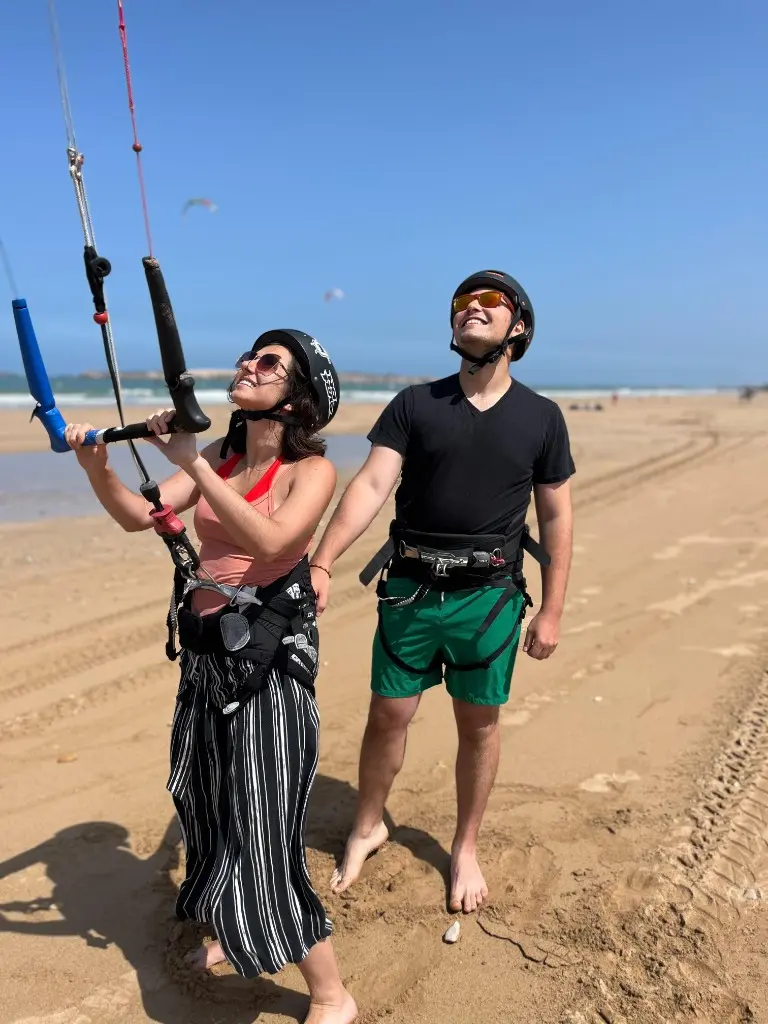
Waterstart kitesurf: complete technique for beginners 2026
TL;DR
Succeed in your waterstart kitesurfing: position, timing, power stroke and mistakes to avoid. IKO step-by-step guide — Essaouira course, protected bay, certified school.
Waterstart kitesurf: successfully start on a board
Quick definition: Waterstart kitesurfing is the maneuver that takes you from sitting in the water to gliding while standing on the board, thanks to a controlled power stroke of the kite. This is the most anticipated moment in learning — and the one that requires the most patience, timing, and solid prerequisites.
Introduction
You fly the kite. You have mastered body drag upwind. It's time to get on the board and slide. The waterstart is the most rewarding stage of beginner kitesurfing: a few seconds of tension, a well-balanced power stroke, and you are standing, propelled by the wind.
However, the waterstart is also the stage where most beginners stagnate the longest. 10, 20, 50 attempts before the first success — that's normal. This guide breaks down each phase of waterstart kitesurfing: position, timing, power stroke, errors and exercises to accelerate your progress.
At Essaouira Surf Camp School, an IKO certified school, we only introduce the waterstart after validation of the body drag upwind — a method which reduces failures and frustration. Essaouira Bay, with more than 300 windy days per year and flat water in the morning, offers the ideal playground.
Prerequisites: kite piloting and body dragging kitesurf mastered.
IKO prerequisites before waterstart
The direct answer: never attempt a waterstart without having validated the body drag upwind over 50 to 100 meters. Otherwise, each fall = lost board + downwind drift + panic.
IKO monitor checklist
| Skill | Validated? | Importance |
|---|---|---|
| Fluid sand piloting | ✓ | Fundamental |
| Body drag downwind 100 m | ✓ | Board recovery |
| Body drag upwind 50 m | ✓ | Return to the edge |
| Board retrieval | ✓ | Autonomy |
| Body drag with board | ✓ | Water start preparation |
| Quick release tested | ✓ | Security |
Ideal conditions for beginner waterstart
- Wind: 15–22 knots (not less than 12, not more than 25 for a beginner)
- Water: flat or slightly choppy — avoid big chop
- Kite: suitable size (often 9–12 m² depending on weight)
- Board: twin-tip 140–160 cm, wide, floating
- Spot: chest height depth, open area
Anatomy of the waterstart: the 5 phases
Here is the complete sequence, phase by phase, as taught by the IKO instructors at Essaouira Surf Camp School.
Phase 1: Initial position
- Plank under the feet or held in front of you, floating
- Sitting position in the water, legs bent, plank in front
- Kite in 12 h (zenith), bar slightly depower
- Immerse the board: the nose (front) slightly underwater, the tail (rear) visible
- Board perpendicular to the direction of the wind (upwind rail facing the wind)
Phase 2: Orientation of the feet
- Front foot in the strap or on the windward side of the board
- Back foot near the tail, ready to push
- Look toward the edge or slightly upwind — never toward the kite
- Hips slightly turned, shoulders relaxed
Phase 3: Power stroke
- Kite descends from 12 p.m. around 10 a.m. (right wind) or 2 p.m. (left wind)
- Fluid and controlled movement — not an aggressive slam
- Progressive traction: feel the bar tighten
- At the moment of maximum traction: push on the legs to stand up
Phase 4: Recovery
- Leg extension — squat-to-stand movement
- Weight on front leg, back leg slightly bent
- Bar at hip height, elbows slightly bent
- Slightly tilted body back — resist pulling
Phase 5: Stabilization and sliding
- From standing: immediate depower (push the bar) to control the speed
- Kite rises gradually in 12 hours
- Looking towards the horizon, shoulders open
- First meters in downwind straight — no immediate turn
- Objective: 50 m of stable sliding before learning the turns
Waterstart twin-tip vs directional
| Criterion | Twin-tip | Directional |
|---|---|---|
| Board orientation | Symmetrical, indifferent | Fixed front foot (regular/goofy) |
| Position straps | Centered | Offbeat |
| Waterstart | Front foot on the wind side | Same principle, longer board |
| Beginner Difficulty | Easier | Slightly more technical |
| Usage | Freestyle, freeride | Waves, strapless possible |
IKO beginners almost always start in twin-tip — more tolerant, symmetrical, wide straps.
Common mistakes in waterstart kitesurfing
Here are the 10 mistakes that block 90% of beginners:
- Board parallel to the wind instead of perpendicular — no planing, board submerges
- Power stroke too violent — power loop, spectacular back fall
- Power stroke too timid — insufficient traction, remains seated
- Looking at the kite — loss of balance, poor board orientation
- Stand up before the pull — reversed timing, guaranteed failure
- Bar pulled to the maximum — overpower, fall; keep 15 cm of depower
- Board too small — insufficient volume, water start impossible
- Wind too weak (< 12 knots) — kite does not pull enough
- Forgetting to depower once standing — uncontrolled acceleration, falling
- Attempt the waterstart without validated body drag — board lost with each fall
Quick diagnosis
| Symptom | Probable cause | Solution |
|---|---|---|
| Violent rear fall | Power stroke too strong | Smoother stroke, more depower |
| Stay seated, no traction | Stroke too low or kite too high | Lower the kite lower, more pronounced stroke |
| Plank dives in front | Weight too much forward | More active rear foot, rear torso |
| Board slides before recovery | Timing: traction too early | Wait for the board to level slightly |
| Immediate side fall | Board incorrectly oriented | Check perpendicularity to the wind |
Progressive exercises to succeed in the waterstart
Exercise 1: Assisted waterstart (instructor holds board)
The instructor stabilizes the board while the student performs the power stroke. Objective: feel the traction-straightening timing without managing the board.
Exercise 2: Waterstart without straps
Feet placed on the board without being attached — less frightening, falls without the board being carried away. Ideal for the first 5 attempts.
Exercise 3: Waterstart in shallow water (prohibited IKO strict — supervised only)
Some lagoons allow hip-height water — the instructor can intervene. Essaouira: practiced only in a supervised area, not independently.
Exercise 4: Waterstart sequence → 50 m slide → controlled stop
Session objective: 5 successful water starts with 50 m of sliding each. The controlled stop (kite in 12 hours, voluntary sitting) is as important as the start.
Exercise 5: Waterstart on the switch side
Once the regular waterstart has been mastered, try the other side — preparation for kitesurf jibe tack turns.
Waterstart progress plan over 3 sessions
| Session | Focus | Objective |
|---|---|---|
| Session 1 | Position + assisted power stroke | 2–3 water starts with assistance |
| Session 2 | Autonomous waterstart, short glide | 5 water starts, 20 m slide |
| Session 3 | Stabilization, glide 50 m+ | 10 water starts, speed control |
Between sessions, visualize the sequence: position → stroke → recovery → depower. Mental visualization accelerates muscle memory according to sports studies and IKO feedback.
Waterstart in Essaouira: the perfect spot
Morning conditions (9 a.m.–12 p.m.)
- flat water in the lagoon
- Wind 12–18 knots — ideal for first water starts
- Fewer chops = fewer variables = more successes
Afternoon conditions (2 p.m.–6 p.m.)
- Wind 18–25 knots — more powerful waterstart, speed progression
- Light chop — preparation in real conditions
- More riders — respect priority rules
Essaouira Surf Camp School
- IKO certified monitors, radio communication
- Suitable equipment: twin-tip 145–160 cm, kites 9–12 m²
- 300+ windy days per year — optimal planning
- Combination of surfing in the morning + kitesurfing in the afternoon possible
Book your waterstart session on our kitesurf page.
After the waterstart: what next?
Once 5 to 10 reliable water starts per session:
- Stable gliding 100 m — speed control, depower, balance
- Upwind sailing — basic upwind sailing (windward edge)
- First tack — upwind turn
- First jibe — downwind turn
- Supervised autonomy — session alone with monitor on board
Consult learn kitesurf beginner for the complete progression and virages kitesurf jibe tack for the rest.
FAQ
Related Posts
Watersports Guide: Surf, Kitesurf & Wing Foil Lessons in Essaouira 2026
Complete Essaouira watersports guide — surf mornings, kite & wing afternoons, IKO/ISA lesson pathways, official prices from €30, seasonal calendar and what to pack for lessons.
Packing List for a 6-Day Surf Camp in Essaouira 2026 | Complete Checklist
What to pack for a 6-day surf camp in Essaouira — wetsuit extras, layering for Atlantic wind, toiletries, electronics and MAD cash tips for Morocco's Wind City.
Guide to Surf Courses in Essaouira 2026 | Formats, Prices & Spots
Complete guide to surf courses in Essaouira — group, semi-private and private lessons from €30, multi-day packs, ISA coaching, lesson roadmap, Sidi Kaouki safaris and booking tips.
Kitesurf Reviews — Essaouira Surf Camp School
Real kitesurf guest experiences in Essaouira, Morocco — IKO & ISA certified school, 5/5 Google rating.
Kitesurf FAQ Essaouira — Questions & Answers
Everything about kitesurf in Essaouira: prices, levels, gear, weather, booking and Morocco spots.