Types of Surfboards: Complete Guide 2026
TL;DR
What are the types of surfboards? Shortboard, longboard, fish, foam, funboard: comparison, uses, and levels. Expert guide to choosing the right board.
Types of Surfboards: Complete Guide for All Levels
Quick definition: Types of surfboards are the different board categories classified by length, volume, shape, and use: foam, longboard, funboard, fish, shortboard, gun, and hybrids. Each type matches a surfer level, wave size, and riding style — from beginner trim to aerials in hollow conditions.
Introduction
You walk into a surf shop or browse online listings and discover a jungle of terms: shortboard, fish, funboard, malibu, softboard… Understanding types of surfboards is the first step to buying, renting, or progressing with equipment suited to your level and the day's conditions.
This exhaustive guide breaks down each board category: typical dimensions, volume, required level, ideal conditions, and pros/cons. Whether you are starting in the bay of Essaouira, looking for a versatile board for South-West France waves, or preparing a surf trip to Portugal, you will know exactly which board type matches your goals.
At Essaouira Surf Camp School, we mainly use foam boards for learning, funboards for transition, and longboards for style sessions. This guide draws on that field experience and international shaper standards (Channel Islands, Firewire, Torq, NSP).
Why Know the Types of Surfboards?
The direct answer: choosing the wrong board type is the number one cause of frustration among beginners and stagnation among intermediates.
Volume and Length: Two Fundamental Criteria
Before talking about "shortboard" or "fish", remember two variables:
- Volume (litres): determines float. The higher the volume, the more easily the board carries the surfer.
- Length (feet and inches): influences stability, paddling, and manoeuvrability.
| Approximate volume | Typical level | Effect |
|---|---|---|
| 120 L+ | Complete beginner | Floats when still, easy take-off |
| 80–120 L | Beginner / transition | Stable, forgives mistakes |
| 50–80 L | Intermediate | Manoeuvrable, demands paddling |
| 25–50 L | Advanced | Reactive, small margin for error |
| < 25 L | Expert / competition | Maximum performance, hollow swell |
How to Read a Board Spec Sheet
On most sites and surf shop labels, you will find:
- Length: 6'2", 8'0", 9'6"…
- Width: width at the widest point (in inches)
- Thickness: thickness at centre
- Volume: in litres (essential since 2015)
- Tail shape: squash, pin, swallow, round…
- Rocker: profile curve (more rocker = more "curved" board, better in hollow waves)
Foam Board (Softboard): The Essential Type for Beginners
The direct answer: the foam board is the most suitable surfboard type for the first 10 to 30 sessions.
Characteristics
- Length: 7'0 to 9'0 (often 8'0 or 8'6)
- Volume: 80 to 130 litres
- Material: expanded foam core covered with soft PE or EVA
- Rails: rounded, no sharp edge
- Leash: often included
Pros and Limits
| Advantages | Limits |
|---|---|
| Safe (reduced impacts) | Slow in a straight line |
| Stable and floaty | Hard to duck-dive |
| Affordable (€150–400) | Limited manoeuvre progression |
| Ideal in whitewater | Bulky to transport |
| No wax needed (integrated grip) | Less durable than epoxy |
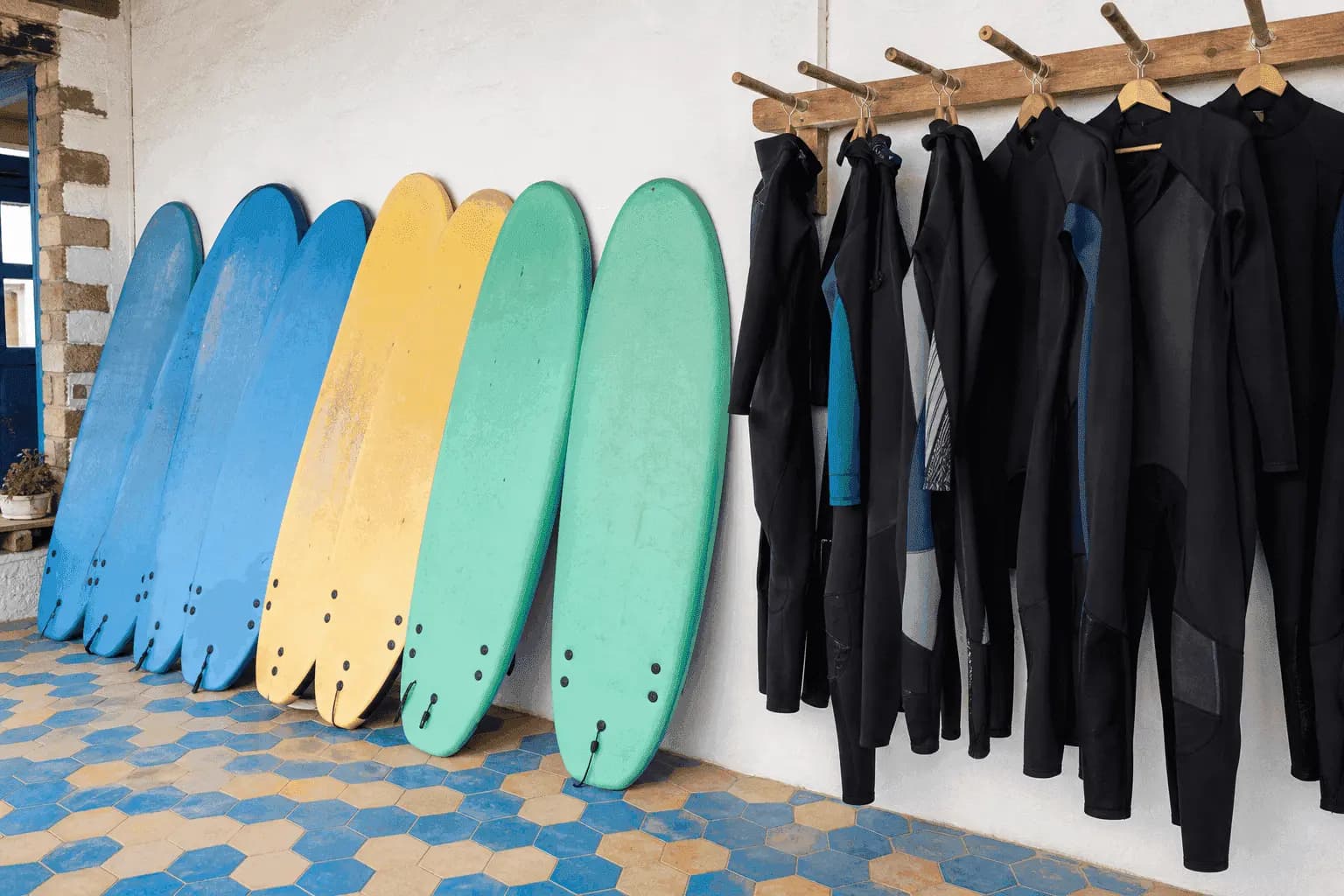
Leading brands: Torq, NSP, Softech, Olaian (Decathlon), BIC Sport. Surf schools worldwide — including in Essaouira — lend this board type because it maximises take-offs and minimises risks.
Longboard: Glide, Style, and Noseriding
The direct answer: the longboard is a board of 9 feet and more, stable and planing, designed for mellow waves and "old school" surfing.
Sub-Categories
- Classic longboard (log): 9'6 to 10'6, heavy, single fin, for pure noseriding
- Performance longboard: 9'0 to 9'6, lighter, thruster or 2+1, modern manoeuvres
- Mini-malibu / Mals: 8'0 to 8'6, transition between funboard and longboard
When to Choose a Longboard?
- Mellow waves (< 1 m), short period
- Intermediate surfer who wants more waves
- Cross-step, hang five, hang ten style
- Spots like Essaouira in the morning with moderate swell and light wind
| Criterion | Longboard | Shortboard |
|---|---|---|
| Length | 9'0 – 10'6+ | 5'6 – 6'10 |
| Volume | 70 – 130 L | 25 – 40 L |
| Paddling | Easy | Demanding |
| Ideal waves | Small to medium | Medium to big, hollow |
| Manoeuvres | Trim, noseride, soft cutback | Snap, aerial, tube |
Funboard and Mini-Malibu: The Transition Board
The direct answer: the funboard (7'0 to 8'6) is the bridge between beginner foam and shortboard, ideal for consolidating take-offs on green waves.
Typical Profile
- Length: 7'2 to 8'0
- Volume: 50 to 75 litres
- Shape: round tail, medium width, moderate rocker
- Material: epoxy or intermediate soft top
The funboard lets you start cutbacks, bottom turns, and trim on the open face without the frustration of a board that is too small. It is the recommended choice when you link 7 take-offs out of 10 on foam and aim for 0.8 to 1.2 m green waves.
Essaouira Surf Camp School tip: after 10 to 15 foam sessions, test a 7'6 funboard on a guided session in the bay — morning conditions (light offshore wind) are perfect for this transition.
Fish: Speed and Versatility in Small/Medium Swell
The direct answer: the fish is a short, wide, thick board with a forked tail (swallow tail), optimised to glide fast without effort on moderately powerful waves.
Distinctive Characteristics
- Length: 5'0 to 6'6 (often 5'8 – 6'0)
- Volume: 35 to 50 litres (a lot for its size)
- Width: very wide at centre (> 21")
- Fins: twin fin or quad
- Rocker: flat to moderate
Fish vs Shortboard
The fish paddles more easily than a shortboard of the same length thanks to its volume and width. It excels in mellow to medium waves (0.8 – 1.5 m) where a performance shortboard would struggle to gain speed. However, it is less suited to tight tubes and big conditions.
Surfer profile: confirmed intermediate to advanced, fluid style, beach break or moderate point break spots.
Shortboard: Performance and Radical Manoeuvres
The direct answer: the shortboard is the reference board for performance surfing — hollow waves, vertical manoeuvres, and maximum speed.
Shortboard Variants
| Type | Length | Use |
|---|---|---|
| Performance shortboard | 5'8 – 6'4 | Hollow waves 1 – 2.5 m |
| Step-up | 6'2 – 6'8 | Swell one notch above daily driver |
| Groveler | 5'4 – 5'10 | Small waves, hidden volume |
| Hybrid shortboard | 6'0 – 6'6 | Fish/short compromise |
Materials
- PU (polyester): traditional flex, classic feel
- Epoxy (EPS): lighter, more durable, superior pop
- Carbon wrap / FutureFlex: targeted stiffness, premium price
Beginner warning: a shortboard is not a surfboard type for learning. Even a high-volume "groveler" demands powerful paddling, precise timing, and advanced wave reading. Pros recommend waiting 30 to 50 sessions before considering this type.
Gun and Big Wave Board: Types for Big Swell
The direct answer: the gun is a long (7'0 – 10'0), narrow board with pronounced rocker, designed exclusively for waves of 2.5 m and more.
When This Type Is Required
- Exposed reef or point break spots (Nazaré, Mavericks, Jaws — experts only)
- XXL swell with long period (> 14 s)
- Experienced surfers with specific training (breath-hold, big wave safety)
For 99% of recreational surfers — including on Moroccan spots like Sidi Kaouki in big winter swell — a step-up or slightly longer shortboard is enough. The gun remains a niche type.
Hybrid Boards and Alternatives
Hybrid (Fish/Shortboard, Groveler/Hybrid)
Modern shapers blur categories: short boards with fish volume, performance longboards with shortboard rails. Examples: Firewire Seaside, Hayden Shapes Hypto Krypto, Torq Mod Fun.
Intermediate Soft Top
Between beginner foam and epoxy: soft deck, rigid hull, intermediate volume (60–80 L). Good safety/performance compromise for transition.
Alaia, Paipo, Vintage Surf Craft
Wooden boards without fins (alaia) or surf bodyboards (paipo): alternative styles, no fins or single fin. Outside standard categories but enrich surf culture.
SUP Surf
Stand-Up Paddle: 8' to 10' very wide board, practised standing with a paddle. Distinct from classic surfing, but some spots allow SUP outside the main line-up.
Comparison Table: All Types of Surfboards
| Type | Length | Volume (L) | Level | Ideal waves | New price (€) |
|---|---|---|---|---|---|
| Foam | 7'0 – 9'0 | 80 – 130 | Beginner | Whitewater, small | 150 – 400 |
| Funboard | 7'0 – 8'6 | 50 – 75 | Beginner+ / inter | Green 0.5 – 1.2 m | 400 – 700 |
| Longboard | 9'0 – 10'6 | 70 – 130 | Beginner to advanced | Mellow, trim | 500 – 1,200 |
| Fish | 5'0 – 6'6 | 35 – 50 | Intermediate+ | Medium 0.8 – 1.5 m | 450 – 900 |
| Shortboard | 5'6 – 6'10 | 25 – 40 | Advanced inter – expert | Hollow 1 – 2.5 m | 500 – 1,000 |
| Gun | 7'0 – 10'0 | 40 – 80 | Expert | XXL 2.5 m+ | 700 – 1,500 |
| Hybrid | 5'8 – 7'0 | 40 – 60 | Inter to advanced | Versatile | 550 – 950 |
Which Board Type for Your Level?
Beginner (0 – 15 sessions)
- Foam board 8'0 – 9'0 exclusively
- Do not jump to funboard too early
- Rent through a school before buying
Intermediate (15 – 80 sessions)
- Funboard or mini-malibu as main board
- Add a fish if you often surf medium waves
- Longboard if you enjoy style sessions and small waves
Advanced (80+ sessions)
- Shortboard daily driver suited to your weight and spot
- Fish or groveler for low swell days
- Step-up for winter swells
Board Types and Conditions in Essaouira
The bay of Essaouira offers ideal terrain to test different board types:
- Morning (6am – 11am): light wind, waves 0.5 – 1 m → foam, funboard, longboard
- Afternoon: trade wind 15 – 25 knots → difficult surf, prefer kitesurf or wing
- Winter (Oct – Mar): Atlantic swell 1 – 2 m → funboard, fish, shortboard for advanced
- Sidi Kaouki (15 km): more powerful beach break → fish, shortboard, step-up
Our school lends foam and funboards; advanced sessions include advice on the ideal quiver for your progression.
Common Mistakes When Choosing Board Type
- Buying a shortboard "to progress fast" — guaranteed reverse effect
- Confusing longboard and funboard — the funboard is shorter and less planing
- Ignoring volume — length alone is not enough
- Copying the pro in the line-up — their board type does not match your level
- One board for everything — a quiver of 2 boards changes the practice
- Neglecting the local spot — a fish in Hossegor in summer ≠ a gun at Nazaré
FAQ
Related Posts
Watersports Guide: Surf, Kitesurf & Wing Foil Lessons in Essaouira 2026
Complete Essaouira watersports guide — surf mornings, kite & wing afternoons, IKO/ISA lesson pathways, official prices from €30, seasonal calendar and what to pack for lessons.
Packing List for a 6-Day Surf Camp in Essaouira 2026 | Complete Checklist
What to pack for a 6-day surf camp in Essaouira — wetsuit extras, layering for Atlantic wind, toiletries, electronics and MAD cash tips for Morocco's Wind City.
Guide to Surf Courses in Essaouira 2026 | Formats, Prices & Spots
Complete guide to surf courses in Essaouira — group, semi-private and private lessons from €30, multi-day packs, ISA coaching, lesson roadmap, Sidi Kaouki safaris and booking tips.
Surf Reviews — Essaouira Surf Camp School
Real surf guest experiences in Essaouira, Morocco — IKO & ISA certified school, 5/5 Google rating.
Surf FAQ Essaouira — Questions & Answers
Everything about surf in Essaouira: prices, levels, gear, weather, booking and Morocco spots.