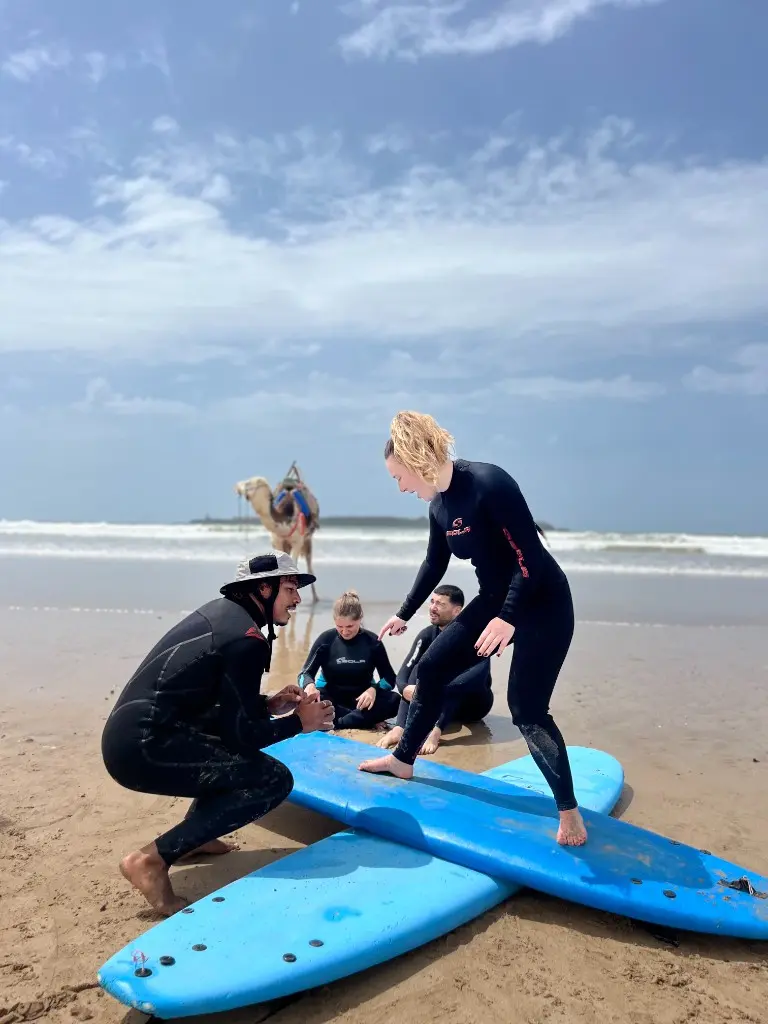
Standing Up on a Surfboard: Pop Up Technique Step by Step 2026
TL;DR
How do you stand up on a surfboard? Pop up, stance, balance, and mistakes to fix. Complete technical guide for beginners — progress from your very first session.
How to Stand Up on a Surfboard: Step-by-Step Technique
Quick definition: Standing up in surfing relies on the pop up — a fluid movement from lying flat to stance — and a low position: feet apart, knees bent, eyes on the horizon. It is the key skill that turns paddling into gliding on the wave face.
Introduction
You paddle, the wave catches you, you push hard… and you fall before even standing up. Frustrating? Normal. Standing up in surfing is the technique every beginner must master before dreaming of bottom turns or cutbacks. Without a clean pop up and a stable surf position, even the best swell will not carry you.
This guide details how to get up on the board step by step: pop up mechanics, weight distribution, dynamic balance, dry-land training, and corrections for the most common mistakes. Whether you surf whitewater in Essaouira, at Côte des Basques, or in Brittany, these universal principles apply on shortboard, funboard, or longboard.
According to ISA-certified instructors, a pop up mastered on sand halves the number of sessions needed to glide standing in the ocean. Professionals recommend 15 to 20 dry-land repetitions before each session — minimal investment for rapid progress.
The Surf Pop Up: Complete Take-Off Mechanics
The direct answer: the pop up is a single upward motion of the torso, followed by simultaneous or near-simultaneous placement of both feet — never a slow, segmented straightening.
Phase 1: Starting Position (Prone)
Lying on the board, chest slightly raised, eyes looking forward (toward the beach). Hands flat under your shoulders, fingers pointing forward. Feet off the tail pad. The leash stays attached to the back ankle — the one that will be at the tail once standing.
Phase 2: The Push (Explosive Push-Up)
In one motion:
- Push hard on your hands to lift your torso
- Bring your hips forward at the same time
- Do not go up on your knees first unless as a last resort
Phase 3: Foot Placement
- Back foot (dominant): place it first on the tail pad or just in front
- Front foot: between your hands, shoulder-width apart, angled 30–45° forward
- Feet should never be parallel to the board (except in very specific cases)
Phase 4: Locking In the Stance
Knees bent, hips low, arms open like counterweights. Eyes fixed on the direction of travel — never on your feet. That is the secret to surf balance from the very first second.
The Ideal Stance for Standing Up in Surfing
Here is how to position your body once standing on the board.
| Element | Correct Position | Common Mistake |
|---|---|---|
| Feet | Shoulder-width, perpendicular to board | Feet too close or too far apart |
| Front foot | Toward the nose, slightly turned | Too far back → nose dive |
| Back foot | On tail pad, slightly open | Too far forward → back-end sink |
| Knees | Bent, supple | Stiff legs, rigid torso |
| Hips | Low, centre of gravity lowered | Upright torso, instability |
| Arms | Open, active | Pressed against body |
| Eyes | Toward beach / wave | Toward feet |
| Weight | Centred, slightly forward in whitewater | Too far back → stall |
On a beginner foam board, a wider stance improves stability. On a shortboard, the stance gradually narrows with skill level.
Pop Up on Sand vs Pop Up in the Ocean: Key Differences
In the ocean, three variables are added: water movement, wave speed, and take-off timing.
On Sand (Training)
- Trace the outline of your board in the sand
- Place yourself in prone position
- Chain 15 consecutive pop ups without pause
- Check foot placement on each repetition
- Film yourself for 30 seconds to self-correct
In the Ocean (Whitewater)
- Position yourself on your stomach, board facing the beach
- Wait for the whitewater to push you (or for an instructor to launch you)
- 3 to 5 powerful paddle strokes
- Immediate pop up — the wave will not wait
- Low stance from the very first instant
According to ISA school experts, optimal timing is: paddle → feel the acceleration → pop up in under one second. Any hesitation = fall or wipeout.
Surf Balance: Distributing Your Weight on the Board
The definition of balance in surfing: constantly adjusting your centre of gravity to stay on the flat face of the board, neither too far forward (nose dive) nor too far back (stall).
The 3 Dynamic Adjustments
- Forward/back: front foot slightly loaded in whitewater; neutral on green waves
- Lateral: lean slightly toward the inside rail in a turn
- Vertical: lower = more stable; higher = more reactive
Complementary Balance Exercises
- Balance board (Indo Board): 5 min per day
- Yoga: warrior pose, tree pose — core strength and proprioception
- Skateboard or surf skate: weight transfer in motion
- Paddling pool: simulate the pop up in shallow water
WSL champions like Kelly Slater insist on a low centre of gravity: it allows you to absorb wave imperfections without falling.
Step-by-Step Guide: Your Pop Up Training Session
Step 1: 10 min warm-up — shoulder rotations, squats, ankle mobility.
Step 2: 20 pop ups on sand, eyes closed for the last 5 (proprioception).
Step 3: 10 pop ups in waist-deep water, board stable.
Step 4: 5 to 10 whitewater waves with single focus: fast pop up, eyes forward.
Step 5: Debrief: note what worked (timing, feet, eyes).
Repeat this cycle 2 to 3 times per week for a month. Progress is exponential after the 5th session if the pop up is practised on land between each outing.
Common Mistakes That Prevent You from Standing Up
The 8 most frequent mistakes when learning to get up on the board:
- Two-step pop up (knee first) — too slow for real waves
- Looking at your feet — the body follows the eyes, guaranteed fall
- Hands too far apart — loss of power in the push
- Straightening up before placing feet — centre of gravity too high
- Front foot too close to the nose in whitewater — nose dive
- Locked knees — no absorption of vibrations
- Arms pressed against body — impossible to correct lateral balance
- Undersized board — even a perfect pop up is not enough
Professionals recommend correcting one variable per session rather than changing everything at once.
Pop Up by Board Type
| Board Type | Stance | Pop Up | Take-Off Difficulty |
|---|---|---|---|
| Foam 9'0 | Wide, feet apart | Standard, forgiving | Easy |
| Funboard 7'6 | Medium | Standard, faster | Moderate |
| Longboard | Wide, front foot forward | Fast or cross step after | Moderate |
| Shortboard | Narrow, back foot at tail | Explosive, precise feet | Difficult |
| Fish | Medium-wide | Fast, slightly forward | Moderate |
Beginners should exclusively work on the pop up on foam or funboard before moving to a shortboard.
FAQ
Related Posts
Watersports Guide: Surf, Kitesurf & Wing Foil Lessons in Essaouira 2026
Complete Essaouira watersports guide — surf mornings, kite & wing afternoons, IKO/ISA lesson pathways, official prices from €30, seasonal calendar and what to pack for lessons.
Packing List for a 6-Day Surf Camp in Essaouira 2026 | Complete Checklist
What to pack for a 6-day surf camp in Essaouira — wetsuit extras, layering for Atlantic wind, toiletries, electronics and MAD cash tips for Morocco's Wind City.
Guide to Surf Courses in Essaouira 2026 | Formats, Prices & Spots
Complete guide to surf courses in Essaouira — group, semi-private and private lessons from €30, multi-day packs, ISA coaching, lesson roadmap, Sidi Kaouki safaris and booking tips.
Surf Reviews — Essaouira Surf Camp School
Real surf guest experiences in Essaouira, Morocco — IKO & ISA certified school, 5/5 Google rating.
Surf FAQ Essaouira — Questions & Answers
Everything about surf in Essaouira: prices, levels, gear, weather, booking and Morocco spots.