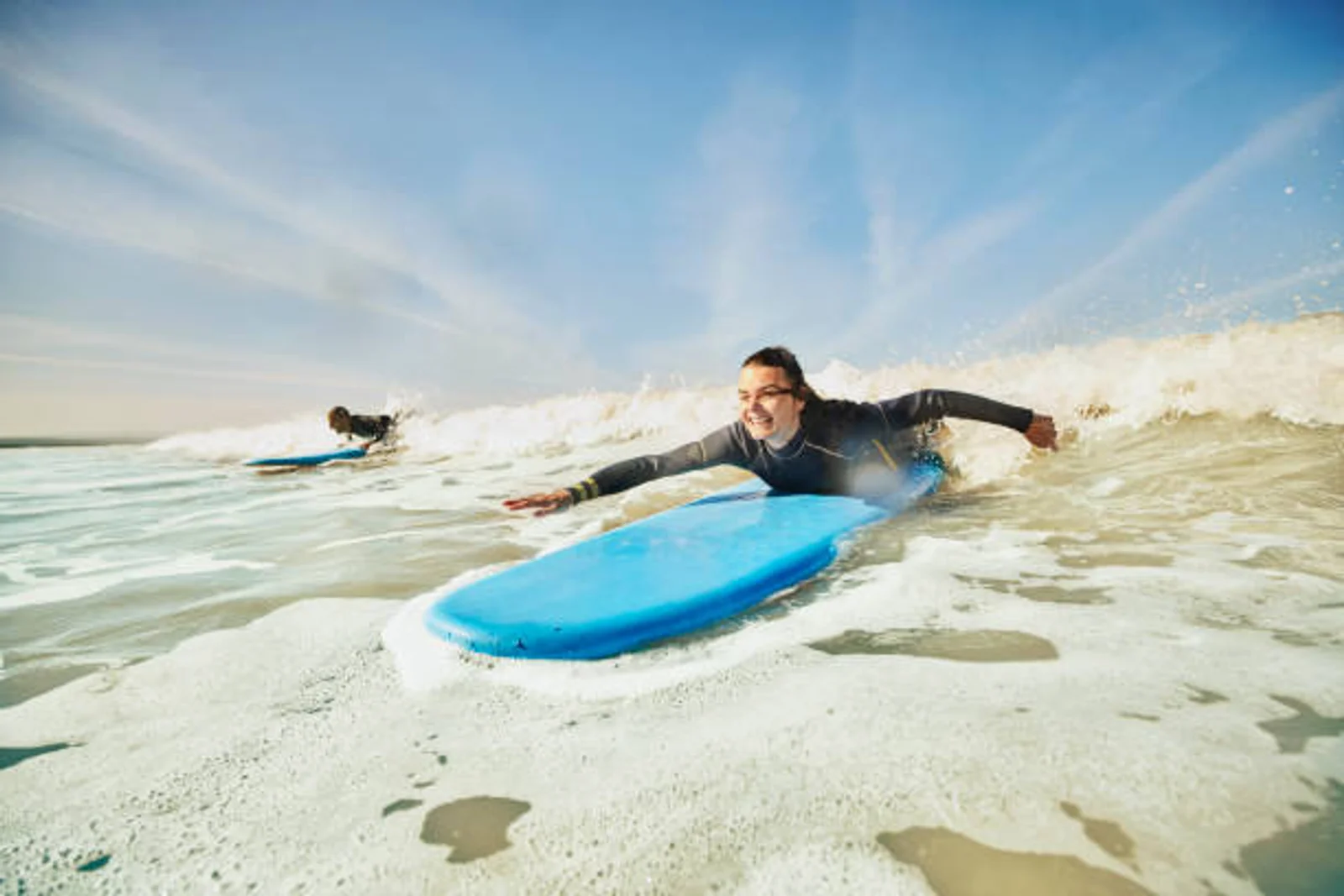
Surf Paddling Technique: Progress Fast in 2026
TL;DR
How do you paddle efficiently in surfing? Position, arms, cadence, and endurance: complete guide to catching more waves. Pro-tested techniques — read the guide.
Surf Paddling Techniques: How to Progress Quickly
Quick definition: Surf paddling technique means propelling the board in a prone position with alternating arm strokes, high elbow, deep hand entry, and core engagement. Efficient paddling lets you catch more waves, exit the shorebreak faster, and position yourself correctly in the line-up.
Introduction
How many waves have you missed because the swell passed you by half a paddle stroke? In surfing, paddling efficiently is as crucial as the pop up or bottom turn. Yet most beginners focus solely on getting up on the board and neglect surf paddling technique — the first skill timed in WSL competition.
This comprehensive guide explains how to improve your paddling: body position, arm mechanics, cadence, nose management, paddle out, and a training programme to develop your paddle power. Whether you surf the bay of Essaouira, Hossegor, or Peniche, these principles apply on foam board, funboard, or shortboard.
According to ISA experts, a surfer who doubles paddle speed virtually doubles take-off chances. Professionals recommend dedicating 20% of each session to paddling in calm conditions before chasing sets.
The Prone Position: Foundation of Efficient Paddling
The direct answer: good paddling starts with a stable position: raised torso, horizontal board, eyes forward, feet off the board or lightly placed for control.
Body Alignment on the Board
- Chest: slightly raised, not lying flat (bodyboard style)
- Pelvis: neutral, neither arched nor collapsed
- Legs: relaxed, ankles off the board or toes on the tail pad
- Head: raised, eyes 10–20 metres ahead
- Arms: hanging between strokes, ready to plunge
Weight Distribution: Avoiding Nose Dive
| Position | Effect | Correction |
|---|---|---|
| Too far forward | Nose dives, enormous drag | Shift torso slightly back |
| Too far back | Board in wheelie, unstable | Move shoulders forward |
| Centred | Board planes, optimal paddle | Target position |
| Flat torso | Shoulders blocked, short strokes | Raise torso |
On a foam board, the sweet spot is wider. On a shortboard, a few centimetres change everything.
Arm Mechanics: How to Paddle Like a Pro
Here is how to execute a perfect paddle stroke in 5 phases.
Phase 1: Deep Immersion
Hand enters the water far ahead of your head, fingers slightly spread, palm facing down. No slap on the surface — silent entry = less drag.
Phase 2: High Elbow (Early Vertical Forearm)
Elbow stays above the hand during the pull. This is the difference between a swimmer's paddle (low elbow, inefficient) and a surfer's paddle (high elbow, powerful).
Phase 3: Pull Along the Board
Pull your hand along the rail to your hip. The movement is long, not short and frantic. Engage your lats and back muscles — not just your biceps.
Phase 4: Clean Hand Exit
Exit the hand laterally at hip height, elbow bent, without dragging your fingers.
Phase 5: Aerial Recovery
Arm returns forward without pause. Cadence: long powerful strokes rather than sterile frenzy.
ISA instructors teach: "Reach, catch, pull, exit, recover" — five words to engrave the mechanics.
Cadence and Timing: When to Accelerate for the Take-Off
The direct answer: paddle hard when the wave reaches you — not before, not after. Timing is half the take-off.
In Whitewater Waves
- Stable position, board perpendicular to the beach
- 2 to 4 powerful strokes when the whitewater arrives
- Immediate pop up at maximum acceleration
On Green Waves
- Observe the set from the line-up
- Turn the board toward the beach (take-off angle)
- Start paddling before the wave reaches you
- 4 to 8 explosive strokes — progressive acceleration
- Last stroke = strongest moment, instant pop up
Table: Paddle Strokes by Conditions
| Condition | Typical Strokes | Intensity | Goal |
|---|---|---|---|
| Whitewater 0.5 m | 2–4 | Moderate to strong | Stable pop up |
| Green wave 0.8 m | 4–6 | Strong | Enter the wave |
| Wave 1.2 m+ | 6–8 | Maximum | Avoid back-end wipeout |
| Paddle out | Continuous | Endurance | Cross the impact zone |
| Catching a set | 5–10 fast | Sprint | Avoid being passed |
Paddle Out: Getting Beyond the Shorebreak
Crossing the impact zone requires a specific technique distinct from take-off paddling.
Strategies by Spot
- Channel / rip current: use the current to exit without paddling (with caution)
- Set timing: leave during the lull between two series
- Turtle roll / dodge: on shortboard, pass under breaking waves
- Duck dive: submerge board and body under the wave (intermediate+ level)
- Paddle sprint: maximum acceleration on the last 10 metres before the impact zone
On a beach break like Essaouira or Biarritz, identify the deepest channel before entering. Locals know these passages — observe before paddling out.
Improving Paddle Power: Training Programme
Professionals recommend cross-training for shoulders, back, and core to prevent injury and increase endurance.
Weekly Programme (2 Out-of-Water Sessions)
Session A — Strength:
- Push-ups: 3 × 12
- Pull-ups or rowing: 3 × 10
- Resistance band paddle simulation: 3 × 15 each arm
- Plank: 3 × 45 seconds
Session B — Endurance:
- Freestyle swimming: 500–800 m
- Burpees: 3 × 10
- Side plank: 3 × 30 s each side
- Jump rope: 3 × 2 min
In the Ocean: Paddle Drills
- 10-stroke sprint: repeat 8 times with 30 s rest
- Paddle in place: 20 powerful strokes without advancing (against light swell)
- Paddle eyes closed: proprioception and consistency
After 4 weeks, most surfers report noticeably better wave-catching.
Common Surf Paddling Mistakes
Here are the 7 mistakes that sabotage your surf paddling technique:
- Looking at your hands — imbalance and short strokes
- Low elbow — swimmer style, zero power
- Slap on hand entry — drag and slowdown
- Paddling too early — fatigue before take-off
- Paddling too late — the wave passes you
- Nose diving — position too far forward on the board
- Frenzy without amplitude — 20 weak strokes < 5 powerful strokes
Correct one variable per session. Film yourself from the side to analyse elbow height.
Paddling and Equipment: Volume, Rocker, and Fins
| Equipment Factor | Impact on Paddling | Advice |
|---|---|---|
| Board volume | More volume = easier paddling | Beginner: 80 L+ |
| Rocker (curvature) | Flatter = faster paddle glide | Flat funboard ideal for beginners |
| Width | Wider = prone stability | Foam 22"+ |
| Fins | Affect drag when paddling | Single fin longboard = glide |
| Wax / grip | Chest adhesion | Chest wax or grip pad |
An incorrectly sized board makes all paddling painful, whatever your technique.
FAQ
Related Posts
Watersports Guide: Surf, Kitesurf & Wing Foil Lessons in Essaouira 2026
Complete Essaouira watersports guide — surf mornings, kite & wing afternoons, IKO/ISA lesson pathways, official prices from €30, seasonal calendar and what to pack for lessons.
Packing List for a 6-Day Surf Camp in Essaouira 2026 | Complete Checklist
What to pack for a 6-day surf camp in Essaouira — wetsuit extras, layering for Atlantic wind, toiletries, electronics and MAD cash tips for Morocco's Wind City.
Guide to Surf Courses in Essaouira 2026 | Formats, Prices & Spots
Complete guide to surf courses in Essaouira — group, semi-private and private lessons from €30, multi-day packs, ISA coaching, lesson roadmap, Sidi Kaouki safaris and booking tips.
Surf Reviews — Essaouira Surf Camp School
Real surf guest experiences in Essaouira, Morocco — IKO & ISA certified school, 5/5 Google rating.
Surf FAQ Essaouira — Questions & Answers
Everything about surf in Essaouira: prices, levels, gear, weather, booking and Morocco spots.