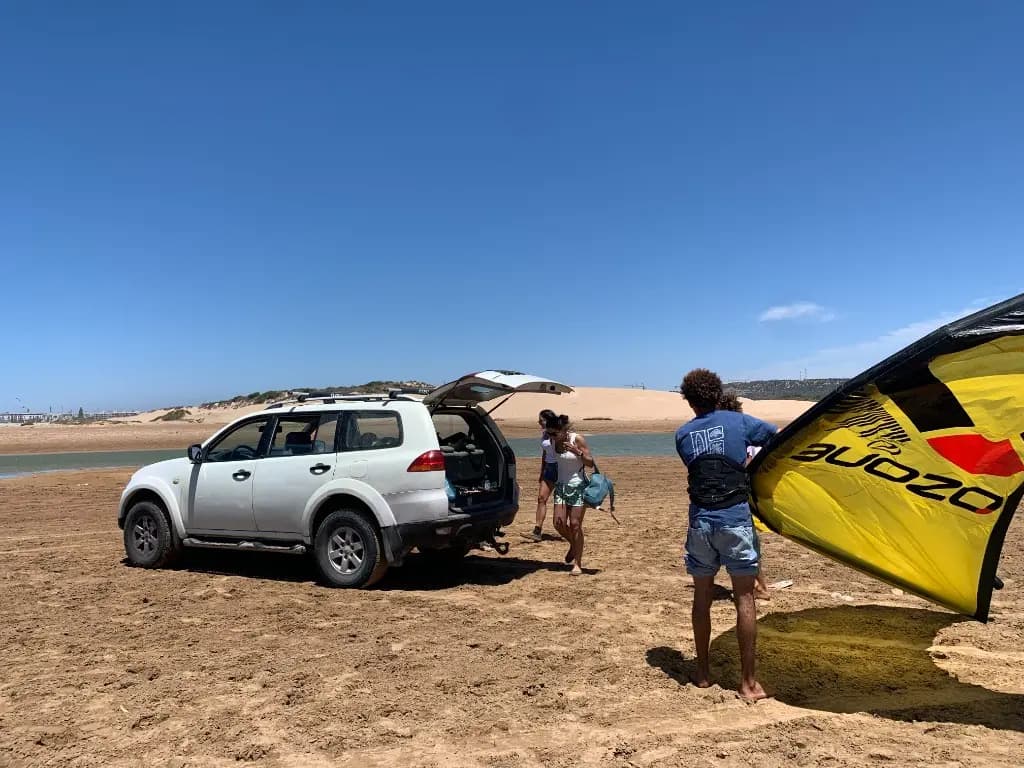
Technical kitesurf jumps: complete pop, grab and progression guide 2026
TL;DR
Master technical kitesurfing jumps: pop, kite timing, grab and landing. IKO expert guide to progress in freestyle — book your coaching in Essaouira.
Technical kitesurf jumps: pop, grab and freestyle progression
Quick definition: Technical kitesurf jumps combine a powerful pop on a twin-tip board, a precise delivery of the kite towards the zenith (wind window) and control of the body in the air to land on the edge. The pop generates the vertical impulse; the kite provides height and reach.
Introduction
Are you already carving edges, doing jibes and dreaming of taking off over the water? Technical kitesurf jumps represent the gateway to freestyle: pop, grab, rotation and aerial style. Contrary to popular belief, the height does not depend solely on the size of the kite — it depends on the bar-kite timing, the quality of the carve and the management of the harness.
This guide details the complete progression: IKO prerequisites, pop mechanics, types of jumps (small jump, sent jump, kiteloop jump), essential grabs, frequent errors and suitable spots. Whether you progress on the Essaouira lagoon, in Leucate or in Brittany, the principles remain the same. At Essaouira Surf Camp School, our IKO instructors guide French-speaking riders towards their first clean jumps thanks to the flat water and constant trade winds of the bay.
According to the International Kiteboarding Organization (IKO), an experienced level 3 rider can tackle small jumps after 30 to 50 hours of supervised practice. The key: structured progression, suitable equipment and compliance with kite safety rules.
Prerequisites: what level for technical kitesurf jumps?
The direct answer: you must master the waterstart in both directions, jibe turns, controlling the kite in a wind window and relaunch alone before attempting any jump.
IKO checklist before the first pop
| Skill | Required level | Why it is essential |
|---|---|---|
| Waterstart | Automatic back/front | Leave quickly after landing fall |
| Jibe/tack | Fluid 10+ chained | Repositioning and return to the spot |
| Edge / carver | Comfortable Upwind | Load the board for the pop |
| Relaunch | Alone, deep water | Safety if falling far from the edge |
| Wind Window | Basic blind piloting | Send the kite to the zenith without looking |
| Upwind Drag Bodysuit | Mastered | Return to equipment after fall |
Recommended equipment for jumps
- Kite: C-kite or hybrid depending on preference; bow/delta for more safety margin when starting jumps
- Twin-tip board: 136–142 cm, moderate rocker, medium flex to absorb landings
- Harness: belt with good lumbar support; the hook must be accessible for quick release if necessary
- Control bar: adjusted trim — bar neither too tight nor too loose
- Safety leash: always connected; check the quick release before each session
Instructors recommend starting jumps with a slightly undersailed kite: more responsiveness, less risk of being carried away in the event of a timing error.
The mechanics of pop: foundation of technical kitesurf jumps
Here's how to structure a clean pop — the basis of all advanced technical kitesurfing jumps.
Step 1: Loaded edge approach
Approach in a powerful carve, knees bent, weight on the back leg, board inclined rail against the water. Moderate to high speed: too slow = no pop; too fast = loss of control. The edge creates tension in the kite lines and prepares the spring of the board.
Step 2: Bar-kite timing
At the moment of the pop, send the kite gradually towards the zenith (12 o'clock). Classic mistake: pull suddenly on the bar - the kite stalls and you fall without height. Pros recommend a smooth movement over 1 to 2 seconds, synchronizing with leg extension.
Step 3: Extension and takeoff
Unload the board by pushing hard on the legs (pop). Your bust remains compact, looking towards the beach or the landing point. Arms slightly bent: the control bar remains at the level of the harness, not above the head.
Step 4: Aerial phase and landing
In the air, keep the kite stable at the zenith or slightly forward (1 hour–2 hours depending on the wind). Bend your knees upon landing, return to the edge immediately and continue your trajectory. Landing flat on your back is a sign of a poorly timed pop or a kite that is too late.
Types of kitesurf jumps: from small jump to kiteloop
Small jump
Height 1–2 m, kite at zenith, moderate pop. Ideal for the first 10 jumping sessions. Objective: land on edge, hands stable, no grab. This is the foundation — don't move to sent jump until 20 consecutive small jumps are clean.
Sent jump
The kite is sent forward (wind window) to create reach and height. More demanding timing: the kite must cross the wind window during the pop. Higher risk if the wind is irregular; practice on flat water, stable trade wind (typical of Essaouira in the afternoon).
Kiteloop jump
The kite loops during the jump. Reserved for advanced riders with excellent quick release and leash control. Never attempt a kiteloop without specialized coaching: the power generated can be extreme.
Tabletop and Indy grab
Once the pop is mastered, add a grab: grab the twin-tip board in the air. Indy (rear hand between the feet, toe-side) and tail grab (rear hand on the tail) are the first grabs taught in the IKO school.
Comparison table: kitesurf jumps by level
| Jump type | IKO level | Average height | Risk | Ideal spot |
|---|---|---|---|---|
| Small jump | 3 | 1–2m | Low | Flat lagoon, protected bay |
| Pop + grab | 3+ | 2–3m | Moderate | Flat water, wind 18–25 knots |
| Sent jump | 4 | 3–5m | Moderate-high | Constant trade wind |
| Kiteloop jump | 4+ | 4–8m | High | Spot open, rescue available |
| Unhooked jump | 4+ | Varies | High | Mandatory dedicated coaching |
Practical advice: 4-week progress plan
Week 1 — Foundations: 3 sessions dedicated to loaded carving without jumping. Work on edge, speed and blind piloting (kite at the zenith with your eyes closed for 3 seconds).
Week 2 — Small jumps: 10 to 15 small jumps per session, focus on landing. Film yourself or ask for IKO monitor feedback via BBTalkin radio.
Week 3 — Height and grab: Introduce the Indy grab on small jumps. Gradually increase the sending of the kite.
Week 4 — Sent jump and style: If conditions permit, attempt 3 to 5 supervised sent jumps. Systematic debriefing after each fall.
Between sessions, fitness kite targets the quadriceps, core and ankle flexibility. Squats, planks and box jumps directly improve the quality of the pop.
Common errors in technical kitesurfing jumps
Here are the 7 most frequent errors:
- Pulling the bar too early — the kite stalls, zero height
- Pop without edge — glides flat, no vertical impulse
- Looking at the kite in the air — loss of balance and bad landing
- Landing with straight legs — lumbar shock, risk of injury
- Over-sailed kites — kite too powerful, loss of control in the air
- Unsuitable spot — waves, rocks or dense crowds = danger
- Ignore the quick release — check it before every session, without exception
According to IKO instructors, 80% of first jump failures come from poor bar-kite timing, not a lack of strength.
Recommended spots for kitesurfing jumps
In Morocco
- Essaouira — Bay: flat water at mid-tide, trade wind 18–28 knots, sandy bottom — reference spot for freestyle progression
- Sidi Kaouki: lagoon and flat area, less crowds in the morning
- Dakhla — Lagoon: ultra flat water, constant wind all year round
In France and Europe
- Leucate — Étang de Leucate: historic freestyle spot, flat water
- Almanarre (Hyères): regular wind, demarcated practice areas
- Tarifa (Spain): strong wind, reserved for experienced riders
Kitesurf weather tools
- Windguru and Windy for wind speed and direction
- Tide forecast for water depth in Essaouira
- Course validation 24 hours in advance with your IKO school
FAQ
Related Posts
Watersports Guide: Surf, Kitesurf & Wing Foil Lessons in Essaouira 2026
Complete Essaouira watersports guide — surf mornings, kite & wing afternoons, IKO/ISA lesson pathways, official prices from €30, seasonal calendar and what to pack for lessons.
Packing List for a 6-Day Surf Camp in Essaouira 2026 | Complete Checklist
What to pack for a 6-day surf camp in Essaouira — wetsuit extras, layering for Atlantic wind, toiletries, electronics and MAD cash tips for Morocco's Wind City.
Guide to Surf Courses in Essaouira 2026 | Formats, Prices & Spots
Complete guide to surf courses in Essaouira — group, semi-private and private lessons from €30, multi-day packs, ISA coaching, lesson roadmap, Sidi Kaouki safaris and booking tips.
Kitesurf Reviews — Essaouira Surf Camp School
Real kitesurf guest experiences in Essaouira, Morocco — IKO & ISA certified school, 5/5 Google rating.
Kitesurf FAQ Essaouira — Questions & Answers
Everything about kitesurf in Essaouira: prices, levels, gear, weather, booking and Morocco spots.