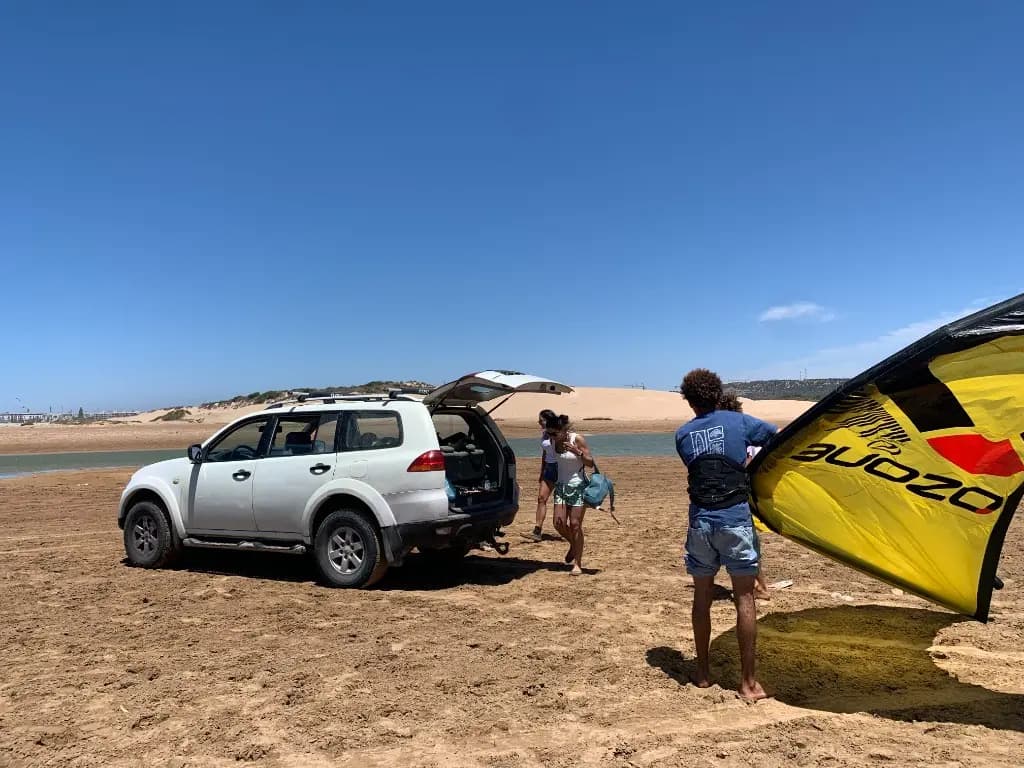
Kitesurfing downwind downwind: complete navigation guide 2026
TL;DR
Master downwind kitesurfing: position, speed, safety and downwinders. IKO expert guide — go downwinding from Essaouira with Essaouira Surf Camp School.
Downwind downwind kitesurfing: navigation, speed and downwinders
Quick definition: Downwind tailwind kitesurfing consists of sailing in the direction where the wind is blowing, with the kite pushing the rider forward. The downwinder is an organized crossing along the coast, from a starting point to an arrival point, with logistical support.
Introduction
Sailing in downwind means feeling the kite propel you at full speed along the coast — a unique sensation between free gliding and controlled adrenaline. Whether for a simple downwind run on Essaouira Bay or a legendary downwinder to Sidi Kaouki, mastering the tailwind is an essential skill for any intermediate and advanced kitesurfer.
This guide covers downwind sailing technique, body position, speed management, safety in open seas, organizing a downwinder and the best spots in Morocco and Europe. At Essaouira Surf Camp School, we organize supervised downwinders along the Atlantic coast — an unmissable experience for French-speaking riders looking for progression and adventure.
According to the IKO, downwind navigation is learned after mastering jibe turns and controlling the kite in a wind window. Allow 20 to 40 hours of freeride practice before attempting an autonomous downwinder of more than 5 km.
Understanding tailwind in kitesurfing
The direct answer: in downwind, the wind blows from behind the rider towards the front. The kite works in its maximum power zone — navigation is fast but control requires experience.
The three wind directions
| Guidance | Wind direction | Difficulty | Usage |
|---|---|---|---|
| Upwind | Facing the wind | High | Return to starting point |
| Cross-shore (cross) | Perpendicular | Moderate | Side navigation |
| Downwind (rear) | In the back | Moderate-high | Speed, downwinders |
Wind window and kite position
In downwind, the kite is generally positioned between 1 o'clock and 2 o'clock (right edge) or 10 a.m.–11 a.m. (left edge) depending on your trajectory. Avoid prolonged zenith: the kite loses efficiency and may fall if the wind weakens. IKO instructors teach active steering: micro-adjustments of the control bar to maintain tension and speed.
Kitesurf downwind navigation technique
Here's how to structure your body position for an efficient and comfortable downwind.
Body position
- Weight: lightly on the front leg, knees bent
- Bust: oriented slightly towards the kite, not forward
- Arms: control bar at harness level, elbows relaxed
- Look: 50 m ahead — rocks, waves, other riders
- Twin-tip board: low angle, board almost flat on the water
Speed management
Downwind speed can exceed 40 km/h with a properly sized kite. To slow down:
- Raise the kite towards the zenith
- Press the control bar (depower)
- Carve lightly with a transverse edge
To accelerate: lower the kite into the wind window (1 o'clock or 11 o'clock) and shift your weight forward.
Downwind turns
The downwind jibe is the key figure: rapid transition without losing speed. On a downwinder, do a series of jibes to stay close to the coast without going upwind. Practice 20 downwind jibes on the bay before a long downwinder.
The downwinder: organization and security
What is a downwinder?
A downwinder is a kite crossing along the coast, from point A to point B, generally with the wind at your back for the entire distance. Famous examples:
- Essaouira → Sidi Kaouki (25 km) — one of the most beautiful in the world
- Leucate → La Franqui (15 km) — Mediterranean
- Tarifa → Valdevaqueros (8 km) — Spanish Atlantic
Checklist before a downwinder
| Element | Detail | Responsible |
|---|---|---|
| Support vehicle | Van or 4x4 along the coast | Organizer |
| Communication | Waterproof radio or phone | All riders |
| Weather | Wind 18–28 knots, stable 4 h+ | IKO Monitor |
| Tide | Check depth and beach access | Organizer |
| Group | 4–8 riders max, uniform level | Monitor |
| Security | Quick release tested, leash, optional helmet | Every rider |
| Water and snacks | On the support vehicle | Organizer |
Downwind security rules
- Never go alone on a downwinder of more than 5 km
- Support vehicle obligatory for coastal crossings
- Stay in a group — the slowest rider sets the pace
- Know the exits: beaches, access, prohibited areas
- Quick release: everyone must know how to self-rescue in open seas
- Respect wildlife and swimming areas
- Stop if the wind weakens below 15 knots — risk of not reaching the finish
Downwinder Essaouira–Sidi Kaouki: the Moroccan classic
Essaouira Surf Camp School regularly organizes the downwinder Essaouira → Sidi Kaouki, considered one of the most spectacular in the world.
Course characteristics
- Distance: approximately 25 km
- Duration: 1h30 to 2h30 depending on level and conditions
- Wind: trade wind from the northeast, 18–28 knots in the afternoon
- Landscape: cliffs, wild beaches, dunes, Sidi Kaouki spot on arrival
- Difficulty: intermediate — moderate waves, some shorebreak zones
Typical procedure
- Safety and weather briefing at Essaouira Surf Camp School
- Departure from Essaouira Bay (high tide recommended)
- Group navigation with IKO monitor and support van
- Mid-course break if conditions require it
- Arrival in Sidi Kaouki — surf session or rest on the beach
- Return by van to Essaouira
Best season
April to October: most regular trade winds. May to September: warmer water, ideal conditions for multi-day kite camp downwinders.
Equipment for downwind kitesurfing
| Equipment | Downwind recommendation | Notes |
|---|---|---|
| Kite | Freeride 9–12 m² | Bigger than freestyle |
| Board | Twin-tip 138–145 cm | Long distance comfort |
| Harness | Belt with seat option | Lumbar support for 2 hours+ |
| Combination | 3/2 mm minimum | Long sessions, fresh wind |
| GPS / watch | Recommended | Distance and speed tracking |
| Impact vest | Optional | Shorebreak arriving |
For long downwinders, some riders opt for a strapless directional board — more comfort in navigation but more technical jibes.
Practical advice: progress in downwind
Stage 1 — Essaouira Bay: Downwind runs from 500 m to 1 km, return in upwind body drag or walk on the beach. Purpose: speed and stop control.
Stage 2 — Downwind jibes: 30 jibes in downwind conditions. Objective: non-stop transitions.
Stage 3 — Intermediate run: Essaouira → Tafedna beach (8 km) with support. First coastal experience.
Stage 4 — Complete Downwinder: Essaouira → Sidi Kaouki with Essaouira Surf Camp School. Objective: complete group tour.
Downwind fitness: cardiovascular endurance, core strength, squat — long sessions work the lower back and quadriceps.
Common mistakes in downwind kitesurfing
- Kite flying at permanent zenith — falls if the wind weakens
- Excessive speed — loss of control during shorebreak
- Solo Downwinder without support — impossible to recover in case of hardware failure
- Ignore the tide — areas too shallow or violent shorebreak
- Heterogeneous group — frustration and risks for the less experienced
- Unsuitable equipment — kite too small = not enough power to complete the course
- Underestimate fatigue — 25 km downwind requires body and concentration
Other downwind spots in Europe and Morocco
Morocco
- Dakhla → Pointe du Dragon: lagoon and open sea
- Agadir → Taghazout: Atlantic coast, moderate swell
###France
- Almanarre → Hyères: Mediterranean, regular wind
- Wissant → Calais: Channel, reserved for experts (fluent)
Portugal
- Guincho → Cascais: strong wind, spectacular landscapes
FAQ
Related Posts
Watersports Guide: Surf, Kitesurf & Wing Foil Lessons in Essaouira 2026
Complete Essaouira watersports guide — surf mornings, kite & wing afternoons, IKO/ISA lesson pathways, official prices from €30, seasonal calendar and what to pack for lessons.
Packing List for a 6-Day Surf Camp in Essaouira 2026 | Complete Checklist
What to pack for a 6-day surf camp in Essaouira — wetsuit extras, layering for Atlantic wind, toiletries, electronics and MAD cash tips for Morocco's Wind City.
Guide to Surf Courses in Essaouira 2026 | Formats, Prices & Spots
Complete guide to surf courses in Essaouira — group, semi-private and private lessons from €30, multi-day packs, ISA coaching, lesson roadmap, Sidi Kaouki safaris and booking tips.
Kitesurf Reviews — Essaouira Surf Camp School
Real kitesurf guest experiences in Essaouira, Morocco — IKO & ISA certified school, 5/5 Google rating.
Kitesurf FAQ Essaouira — Questions & Answers
Everything about kitesurf in Essaouira: prices, levels, gear, weather, booking and Morocco spots.