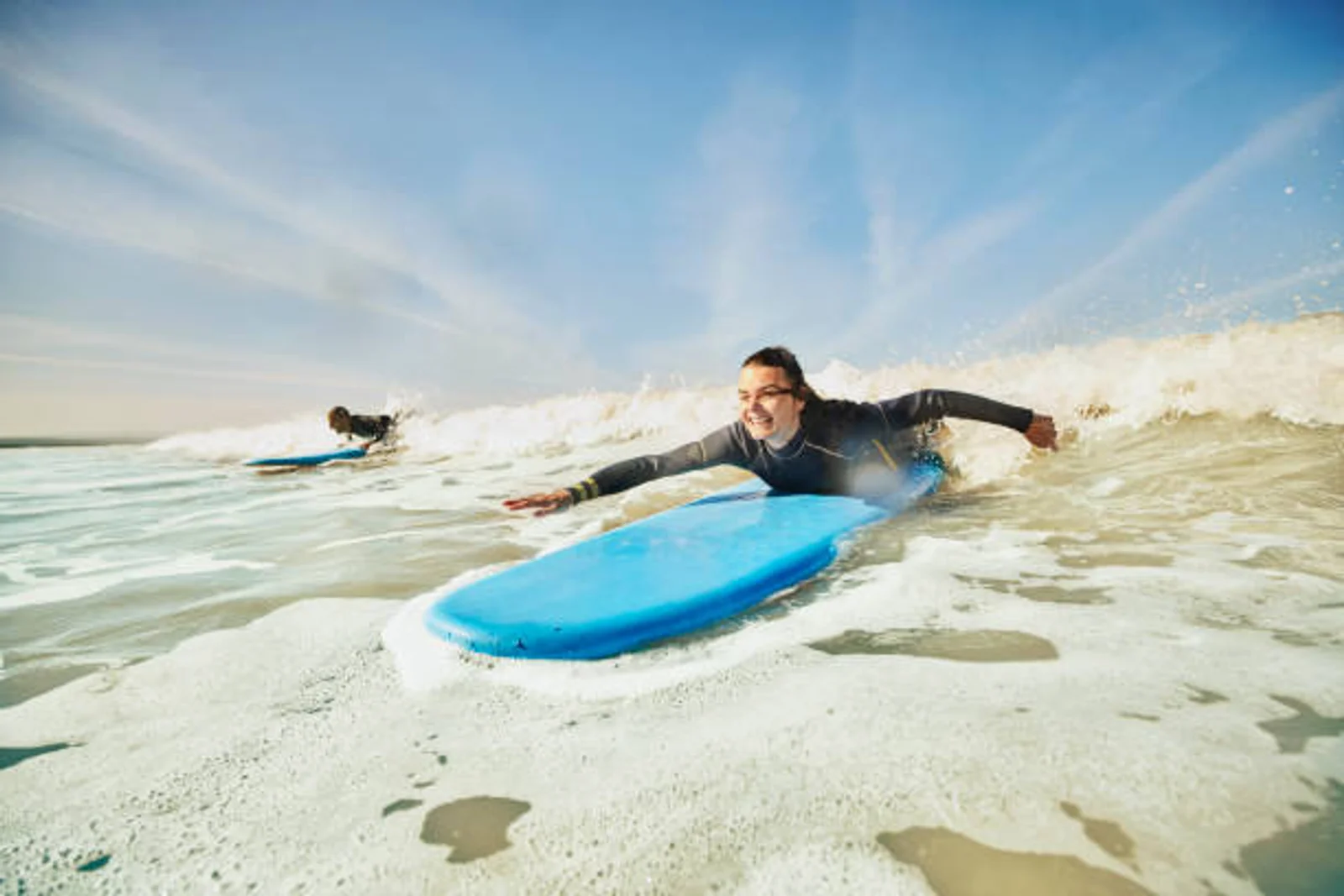
Choose a Surf Wetsuit: Complete Guide 2026
TL;DR
How do you choose a surf wetsuit? 3/2, 4/3 thickness, size, neoprene, and care. Expert guide to stay warm in the water — France, Morocco, Portugal.
Choose a Surf Wetsuit: Complete Guide to Stay Warm in the Water
Quick definition: Choosing a surf wetsuit means selecting a wetsuit suited to water temperature, session length, and your build: thickness (3/2, 4/3, 5/4 mm), type (fullsuit, shorty, spring suit), neoprene quality, and a snug fit to limit cold water entry.
Introduction
You have booked your first surf lesson, or you are preparing a surf trip to Morocco, and one question keeps coming back: which surf wetsuit should you buy, rent, or pack? A poorly suited wetsuit turns a magical session into torture: cold hands, water flushing down your back, paddling hindered by stiff neoprene.
This complete guide explains how to choose a surf wetsuit in 2026: decoding thicknesses, zip types, recognised brands, temperature tables for France, Morocco, and Portugal, plus mistakes to avoid. At Essaouira Surf Camp School, we lend maintained 3/2 and 4/3 wetsuits daily — this field expertise feeds every recommendation in this guide.
Why a Surf Wetsuit Is Essential
The direct answer: neoprene retains a thin layer of water warmed by the body, creating thermal insulation. Without a suitable wetsuit, hypothermia threatens beyond 30 minutes in water < 20 °C.
Physiology and Safety
- Water at 15 °C: loss of finger dexterity in 15–20 min without protection
- Water at 10 °C: hypothermia risk in 30–45 min
- Cold reduces paddling power and concentration — accident factors in the line-up
The wetsuit is not a substitute for swimming ability. It extends comfort and safety, full stop.
Wetsuit vs Rash Guard vs Boardshort
| Equipment | Water temperature | Session length | Protection level |
|---|---|---|---|
| Boardshort only | > 24 °C | 1–2 h | UV only |
| Rash guard | 22–26 °C | 1–2 h | UV + light abrasion |
| 2 mm shorty | 20–24 °C | 1–2 h | Torso + thighs |
| 3/2 spring suit | 18–22 °C | 1–3 h | Long arms, short legs |
| 3/2 fullsuit | 14–20 °C | 2–3 h | Full body |
| 4/3 fullsuit | 10–16 °C | 2–4 h | Body + extra warmth |
| 5/4 fullsuit + accessories | 6–12 °C | 1–3 h | Maximum |
Understanding Thickness: 3/2, 4/3, 5/4 Explained
The direct answer: the first number indicates torso thickness (coldest zone); the second, arms and legs (mobile zones).
Detail by Thickness
2/2 mm wetsuit (shorty)
- Use: water 22–26 °C, Mediterranean summer, Bali, Costa Rica
- Advantages: freedom of movement, easy to put on
- Limits: insufficient for North Atlantic summer
3/2 mm wetsuit (standard fullsuit)
- Use: water 16–20 °C — the bestseller in France and Morocco
- Torso 3 mm, arms/legs 2 mm
- Ideal for Essaouira spring/autumn, Biarritz summer, Portugal summer
4/3 mm wetsuit
- Use: water 12–16 °C — Atlantic winter, Essaouira December–February
- Torso 4 mm, arms/legs 3 mm
- Often lined chest zip, reinforced knees
5/4 mm and 6/5 mm wetsuits
- Use: water 8–12 °C — Brittany winter, Ireland, Scandinavia
- Complete with 3 mm hood, 3 mm gloves, 3 mm booties
Water Temperature → Wetsuit Thickness Table
| Water temperature | Recommended equipment | Example spots |
|---|---|---|
| 24 °C+ | Boardshort + rash guard | Taghazout summer, Canaries |
| 20–24 °C | 2 mm shorty or long rash guard | Essaouira July–August |
| 17–20 °C | Spring 3/2 or full 3/2 | Essaouira May–June, Hossegor summer |
| 14–17 °C | Full 3/2 or 4/3 | Essaouira winter, Biarritz autumn |
| 11–14 °C | Full 4/3 + booties | Brittany autumn, Portugal winter |
| 8–11 °C | Full 5/4 + hood + gloves | Ireland, Northern France winter |
| < 8 °C | 6/5 + full accessories | Norway, Pacific Canada |
Types of Surf Wetsuits
Fullsuit
Covers the entire body, from neck to ankles. The most versatile type for the Atlantic. Number one choice for 80% of European and Moroccan surfers.
Shorty (Shorty Wetsuit)
Short sleeves, short legs. Perfect for summer sessions and warm water. Takes little space in a surf trip bag.
Spring Suit (Anti-Spring)
Long sleeves, short legs — or the reverse. Compromise between shorty and full for 18–22 °C water. Popular in Morocco during transition seasons.
Long John
Sleeveless, long legs. Niche (SUP, very warm water with cool wind).
Zips: Back Zip, Chest Zip, Front Zip
Back Zip
- Advantages: easy to put on alone, often lower price, ideal for beginners
- Disadvantages: possible water entry along zip, less paddling flex
- For whom: beginners, children, tight budget
Chest Zip
- Advantages: superior watertightness, maximum shoulder flexibility, durability
- Disadvantages: trickier to put on, higher price
- For whom: intermediate to advanced, sessions > 1h30
Front Zip
- Rare variant, between back and chest. Some brands use it for accessibility.
Essaouira Surf Camp School tip: for your first lessons, the school's back zip is more than enough. Invest in chest zip when you surf 2–3 times per week.
Neoprene Quality: What Makes the Difference
Standard vs Super Stretch Neoprene
- Standard neoprene: entry level, less flexible, low price
- Super stretch / E4 / Ultraflex: 30–40% more flexibility, superior paddling comfort
- Limestone neoprene: more eco-friendly, often warmer and more durable (Patagonia Yulex, Need Essentials)
Seams: Flatlock vs Blind Stitch vs Taped
| Seam type | Watertightness | Use |
|---|---|---|
| Flatlock | Low (warm water) | Shorty, entry level |
| Blind stitch + glue | Good | Mid-range |
| Blind stitch + internal tape | Excellent | High-end, cold water |
Thermal Linings
Some wetsuits integrate a fleece lining (Quick Dry, Thermo Lining) on the torso to dry faster between sessions and increase warmth without thickening neoprene.
How to Choose Surf Wetsuit Size
The direct answer: a surf wetsuit should be tight when dry — it loosens slightly in the water. Too loose = water flushing; too tight = suffocation and limited paddling.
5-Step Fitting Method
- Height and weight: consult manufacturer size chart (e.g. 1.75 m / 75 kg = MT or L)
- Putting on: difficult = good sign; slides on easily = too big
- Back test: neoprene should hug the spine without vertical folds
- Arm test: raise arms — slight tension OK, no bunching in the elbow crease
- Ankle/wrist test: snug cuff, no air passage
Specific Sizes
- MS, MT, LS, LT: long/torso variations for tall slim or short wide builds
- Women's wetsuit: adjusted hip and chest cut (Rip Curl G-Bomb, O'Neill Bahia)
- Kids wetsuit: sizes by age (8, 10, 12, 14 years) + adapted thickness
Choose a Surf Wetsuit by Destination
France — Atlantic (Biarritz, Hossegor, Lacanau)
- June – September: 3/2 mm fullsuit or spring suit (water 18–22 °C)
- October – May: 4/3 mm, sometimes 5/4 in January–February (water 11–16 °C)
- Winter accessories: 3 mm booties recommended on pebble beaches
Morocco — Essaouira and Taghazout
- Summer: shorty or rash guard (Essaouira windier and cooler than Taghazout)
- Shoulder season: 3/2 mm essential in Essaouira
- Winter: comfortable 4/3 mm, especially morning sessions before trade wind
- Tip: wind chill factor on Essaouira beach justifies one extra thickness vs Agadir
Portugal — Peniche, Ericeira, Algarve
- Similar to French Atlantic
- Southern Algarve: shorty possible July–August
- Peniche/Ericeira winter: 4/3 + booties
Brands and Price Ranges 2026
| Brand | Range | Price (€) | Strengths |
|---|---|---|---|
| Olaian (Decathlon) | Entry | 60–120 | Value for money, availability |
| Alder | Entry | 70–130 | Good for starting |
| Rip Curl | Mid | 150–300 | E4 neoprene, durability |
| Quiksilver / Roxy | Mid | 140–280 | Style, women's/kids cuts |
| XCEL | Mid-high | 180–350 | Thermo dry, chest zip |
| O'Neill | Mid-high | 160–320 | Psycho series, reference |
| Patagonia | High | 300–450 | Eco Yulex, repairability |
| Need Essentials | High | 250–400 | Direct-to-consumer, pro quality |
Buy or rent? Rent through a school for the first 5–10 sessions. Buy when you surf at least once a week for a quarter.
Complementary Accessories
Booties
- 2 mm: warm reef, rock protection
- 3 mm: Atlantic winter
- 5 mm: water < 10 °C
Gloves
- Essential below 12 °C
- 3 mm standard for France winter
Hood
- Below 14 °C or sessions > 2 h in cold water
- 3 mm covers head and neck
Rash Guard Under Wetsuit
- UV protection in warm water
- Extra layer in lukewarm water without fullsuit
- Avoids neoprene irritation on sensitive skin
Care: Extend Your Wetsuit's Life
- Rinse in fresh water after each session — mandatory
- Dry in the shade, never on radiator or direct sun (degrades neoprene)
- Hang on wide hanger or folded at waist — never folded on shoulders
- Neoprene shampoo once a month with intensive use
- Repair tears with neoprene glue (Black Witch) before they grow
- Storage: dry place, flat or hung, away from heat sources
Average lifespan: 2–4 years with proper care, 150–300 sessions.
Common Mistakes When Choosing a Surf Wetsuit
- Buying a size too large "to be comfortable" — guaranteed water flushing
- Underestimating cold in Essaouira — trade wind cools you quickly out of the water
- Neglecting taped seams in water < 15 °C
- Forgetting booties on Brittany or Portuguese pebble beaches
- Machine washing — accelerated neoprene destruction
- Drying wetsuit on sand in full Moroccan sun — premature wear
Surf Wetsuit and Eco-Responsibility
Petrochemical neoprene raises environmental questions. 2026 alternatives:
- Yulex (Patagonia): natural rubber, equivalent performance
- Limestone neoprene: lower CO₂ in production
- B Corp brands: Need Essentials, Patagonia
- Second hand: active market on surf forums and specialised thrift shops
Extending your wetsuit's life (care + repair) remains the most eco-friendly act.
FAQ
Related Posts
Watersports Guide: Surf, Kitesurf & Wing Foil Lessons in Essaouira 2026
Complete Essaouira watersports guide — surf mornings, kite & wing afternoons, IKO/ISA lesson pathways, official prices from €30, seasonal calendar and what to pack for lessons.
Packing List for a 6-Day Surf Camp in Essaouira 2026 | Complete Checklist
What to pack for a 6-day surf camp in Essaouira — wetsuit extras, layering for Atlantic wind, toiletries, electronics and MAD cash tips for Morocco's Wind City.
Guide to Surf Courses in Essaouira 2026 | Formats, Prices & Spots
Complete guide to surf courses in Essaouira — group, semi-private and private lessons from €30, multi-day packs, ISA coaching, lesson roadmap, Sidi Kaouki safaris and booking tips.
Surf Reviews — Essaouira Surf Camp School
Real surf guest experiences in Essaouira, Morocco — IKO & ISA certified school, 5/5 Google rating.
Surf FAQ Essaouira — Questions & Answers
Everything about surf in Essaouira: prices, levels, gear, weather, booking and Morocco spots.