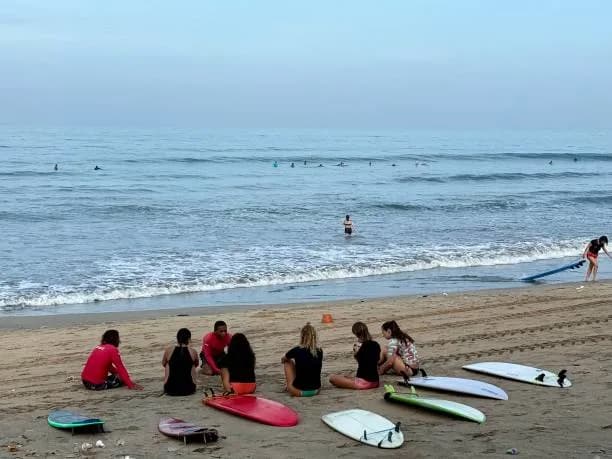
Learn to Surf for Beginners: Complete Guide 2026
TL;DR
How do you learn to surf as a beginner? Steps, gear, spots, and mistakes to avoid. Expert guide for your first waves — book your lesson today.
How to Learn to Surf: Complete Guide for Beginners
Quick definition: Learning to surf as a beginner means mastering ocean safety, paddling, the pop up, and reading waves on a foam board, ideally with a certified instructor. In 2 to 3 coached sessions, most students glide standing on their first whitewater wave.
Introduction
Do you dream of gliding across the ocean, feeling the power of the swell, and experiencing the adrenaline of a successful take-off? Learning to surf as a beginner is more accessible than it seems — provided you follow a structured progression, choose the right equipment, and respect the line-up code.
Whether you are in France, Morocco, Belgium, or a French-speaking part of Canada, this guide explains how to start surfing step by step: physical preparation, spot selection, fundamental techniques, mistakes to avoid, and resources to progress quickly. According to experts from the World Surf League and ISA-certified schools, the key is not brute strength, but consistency, reading the water, and quality coaching.
At Essaouira Surf Camp School, we train hundreds of beginners every year in the bay of Essaouira — a protected beach break, ideal for your first sessions. This guide draws on that field experience, combined with international standards from the Association of Surfing Instructors (ISA).
Why Learn to Surf with a Certified Instructor?
The direct answer: a coached surf lesson reduces risks, accelerates progression, and teaches priority rules from the very first session.
Benefits of a Surf School vs Self-Teaching
Surfing alone without training exposes you to three major dangers: rip currents, line-up collisions, and poor positioning on the wave. An ISA or federation-certified instructor places you on an adapted beach break, away from shorebreak and reefs.
Professionals recommend at least 3 to 5 lessons before practising independently on whitewater waves. Here is what a standard 2-hour lesson generally includes:
- Safety briefing: tide, wind, swimming zone, rip currents
- Warm-up and pop up exercises on the sand
- Paddling and positioning on the board
- Assisted glide on whitewater waves
- Debrief and personalised advice
Where to Learn to Surf: Criteria for a Good Beginner Spot
| Criterion | Ideal Beginner Spot | Spot to Avoid |
|---|---|---|
| Wave type | Beach break, regular whitewater | Reef, violent shorebreak |
| Bottom | Fine sand, gentle slope | Rocks, reefs, drop-offs |
| Swell | 0.5 to 1.2 m | > 1.5 m for a first lesson |
| Wind | Light offshore or calm | Strong onshore (> 20 km/h) |
| Crowd | Few experienced surfers | Saturated line-up |
| Access | Wide beach, school on site | Isolated spot without rescue |
Essaouira (Morocco), Biarritz — Côte des Basques, Lacanau, or Peniche (Portugal) rank among the most recommended destinations for starting to surf with peace of mind.
Key Steps to Learn to Surf as a Beginner
Here is how to structure your progression from day one to your first green waves.
Step 1: Prepare Your Body and Equipment
Before even touching the water, make sure you can swim comfortably in the ocean. Good swimming ability is non-negotiable. Equipment for starting out:
- Foam board 8'0 to 9'0 (volume 80–120 L)
- Wetsuit 3/2 mm in cool season, shorty or rash guard in warm water
- Leash attached to the back ankle (take-off leg)
- Wax or integrated grip depending on the deck
Serious schools include board, wetsuit, and leash in the lesson price — check before booking.
Step 2: Master the Pop Up on the Sand
The pop up (standing up on the board) is the fundamental surf technique. On the sand:
- Lie chest-down on the board, hands under your shoulders
- Push your torso up in one fluid motion
- Bring the back foot first, then the front foot between your hands
- Look toward the beach, knees bent, arms open for balance
Repeat 15 to 20 times before entering the water. According to ISA instructors, a clean pop up on sand halves learning time in the ocean.
Step 3: Paddle Efficiently and Read the Wave
Paddling propels the board toward the wave. Alternate arms, fingers slightly spread, elbow high, eyes looking forward — never at your hands. Powerful paddling lets you catch more waves and progress faster.
To read waves as a beginner:
- Observe where waves break most consistently (the peak)
- Spot the sets (series of larger waves) and lulls (calm periods)
- Position yourself beside the line-up, not directly facing the shorebreak
Step 4: Catch Your First Whitewater Wave
In whitewater (already broken wave), the instructor pushes you or signals when to paddle. Timing: strong paddle for 3 to 5 strokes, quick pop up, low stance. Aim for a straight trim glide before trying turns.
What Gear for Starting to Surf? Board Comparison
The definition of a good beginner board: enough volume to float while stationary, generous width for stability, soft material to limit impacts.
| Board | Volume | Level | Advantages | Disadvantages |
|---|---|---|---|---|
| Foam 8'0 | 80–90 L | Beginner | Stable, safe, affordable | Slow, limited progression |
| Foam 9'0 | 100–120 L | Beginner+ | Very stable, easy take-off | Bulky, difficult to transport |
| Funboard 7'6 | 60–75 L | Intermediate | Versatile, manoeuvrable | Too small for a true beginner |
| Longboard 9'0+ | 90–130 L | Beginner / style | Old-school glide, noseriding | Heavy, less reactive |
Recognised brands for learning: Torq, NSP, BIC Sport, Softech, and Olaian (Decathlon). Pros recommend renting or borrowing before buying.
Practical Tips: Your 4-Week Plan
Step 1 — Week 1: 2 coached lessons on a foam board. Goal: automatic pop up, 5 to 10 glided waves.
Step 2 — Week 2: 1 lesson + 1 independent whitewater session (if the instructor approves). Goal: paddle alone, choose your wave.
Step 3 — Week 3: Work on take-off on small green waves (open face). Goal: drop angle, trim line.
Step 4 — Week 4: Guided session or surf trip (e.g. Sidi Kaouki from Essaouira). Goal: read a new spot, respect priority.
Between sessions, surf fitness helps enormously: push-ups, core work, yoga, and swimming twice a week. Surf physical preparation targets shoulders, core, and balance.
Common Beginner Surf Mistakes
Here are the 7 most frequent mistakes when learning to surf:
- Choosing a board that is too small — guaranteed frustration, zero take-off
- Looking at your feet during the pop up — immediate loss of balance
- Surfing a spot that is too difficult — reef, shorebreak, or swell > 1.5 m
- Ignoring priority rules — the surfer closest to the peak has priority
- Neglecting warm-up — shoulders and back often injured among beginners
- Paddling with arms only — engage your core for more power
- Giving up after 2 sessions — surf progression requires consistency
According to professionals, consistency beats talent: 1 session per week minimum for 2 months transforms a beginner into an autonomous surfer on modest green waves.
Recommended Spots and Resources to Progress
In France
- Biarritz — Côte des Basques: historic beach break, many schools
- Hossegor — La Sud: gentle waves in summer, ideal for families
- Lacanau: long beach, regular whitewater
- Brittany — La Torche: variable conditions, experienced local schools
In Morocco
- Essaouira: protected bay, moderate Atlantic swell, trade wind in the afternoon — perfect for combining morning surf and afternoon kitesurf
- Taghazout — Panorama / Hash Point: legendary surf destination, beginner to intermediate level
- Sidi Kaouki: powerful beach break, ideal on a guided surf trip from Essaouira
Surf Weather Tools
- Windguru and Magic Seaweed (MSW) for swell, period, and direction
- Surf-forecast.com for spot-specific forecasts
- Local school apps for lesson confirmation 24 h in advance
FAQ
Related Posts
Watersports Guide: Surf, Kitesurf & Wing Foil Lessons in Essaouira 2026
Complete Essaouira watersports guide — surf mornings, kite & wing afternoons, IKO/ISA lesson pathways, official prices from €30, seasonal calendar and what to pack for lessons.
Packing List for a 6-Day Surf Camp in Essaouira 2026 | Complete Checklist
What to pack for a 6-day surf camp in Essaouira — wetsuit extras, layering for Atlantic wind, toiletries, electronics and MAD cash tips for Morocco's Wind City.
Guide to Surf Courses in Essaouira 2026 | Formats, Prices & Spots
Complete guide to surf courses in Essaouira — group, semi-private and private lessons from €30, multi-day packs, ISA coaching, lesson roadmap, Sidi Kaouki safaris and booking tips.
Surf Reviews — Essaouira Surf Camp School
Real surf guest experiences in Essaouira, Morocco — IKO & ISA certified school, 5/5 Google rating.
Surf FAQ Essaouira — Questions & Answers
Everything about surf in Essaouira: prices, levels, gear, weather, booking and Morocco spots.