Surf Fins: Complete Guide 2026
TL;DR
How do you choose surf fins? Thruster, twin, quad, single fin: sizes, FCS vs Futures, flex, and setup. Expert guide to optimise your board.
Surf Fins: Complete Guide to Choose and Optimise
Quick definition: Surf fins are the foils fixed under the board that provide stability, rail hold, and manoeuvrability. The setup (single, twin, thruster, quad) and size (XS to XL) determine riding behaviour — well-matched fins turn an average board into a custom-fit board for your level and conditions.
Introduction
You look at the bottom of your board: two, three, or four fins fixed in boxes. These small hydrodynamic surfaces play a major role in your surfing — often underestimated by beginners, decisive for intermediates and advanced surfers.
This exhaustive guide explains how to choose surf fins: setup types, FCS vs Futures systems, sizes, materials, flex, and impact on each manoeuvre. Whether you surf a 7'6 funboard in Essaouira or a 6'1 shortboard in Hossegor, you will finally understand what your fins change — and how to optimise them in 2026.
At Essaouira Surf Camp School, we check the fin setup on every rental board. This expertise feeds the recommendations in this surf fins guide.
What Do Fins Do on a Surfboard?
The direct answer: fins create hydrodynamic force that stops the board from sliding sideways, while allowing controlled turns.
Simplified Physics
When the board moves forward, water flows along the fins. Their profile (foil) generates:
- Drive: acceleration in bottom turn
- Hold: rail grip in turns
- Release: end of manoeuvre, controlled slide
- Stability: straight-line trajectory (trim)
Without fins, a board would glide like a boat without a rudder — impossible to turn cleanly.
Fin Anatomy
| Part | Role |
|---|---|
| Base | Fixing surface, force transfer |
| Depth (height) | Lateral hold — deeper = more hold |
| Base length | Drive and stability |
| Rake (sweep) | Manoeuvrability — more rake = wider turns |
| Foil | Aerodynamic profile, flexibility |
| Cant (angle) | Influences rail-to-rail |
The 4 Main Fin Setups
Single Fin (1 fin)
- Use: longboards, alaia, retro surf
- Behaviour: fluid glide, wide turns, noseriding
- Level: beginner longboard to advanced
- Typical size: 9" for 9'0 longboard
Advantages: simplicity, style, less drag
Limits: reduced manoeuvrability in fast hollow waves
Twin Fin (2 fins)
- Use: fish, retro shortboards, small wave boards
- Behaviour: fast, loose, effortless glide
- Level: intermediate to advanced
- Position: fins closer to rails
Advantages: speed in small swell, skate sensation
Limits: less stable in big waves, slide in bottom turn if poorly dosed
Thruster (3 fins — 2 side + 1 centre)
- Use: 90% of shortboards, performance funboards
- Behaviour: stability / manoeuvrability / drive balance
- Level: all levels (size/flex adapted)
- Invented by: Simon Anderson (1980)
Advantages: universal setup, tight turns, predictable
Limits: slightly more drag than twin in micro waves
Quad (4 fins)
- Use: small wave boards, modern fish, grovelers
- Behaviour: maximum speed, drive in mellow conditions
- Level: intermediate to advanced
- Variant: 4 fins or 5 fin setup (quad + optional centre)
Advantages: instant acceleration, fun in waves < 1 m
Limits: less control in tubes and big waves
Setup Comparison Table
| Setup | Fins | Stability | Speed | Manoeuvrability | Ideal waves |
|---|---|---|---|---|---|
| Single | 1 | ★★★☆☆ | ★★★☆☆ | ★★☆☆☆ | Mellow, longboard |
| Twin | 2 | ★★☆☆☆ | ★★★★★ | ★★★★☆ | Small/medium |
| Thruster | 3 | ★★★★☆ | ★★★☆☆ | ★★★★☆ | All (versatile) |
| Quad | 4 | ★★★☆☆ | ★★★★★ | ★★★☆☆ | Small, generous |
FCS vs Futures: The Two Fin Box Systems
The direct answer: your board is pre-equipped FCS or Futures — you must buy compatible fins. Systems are not interchangeable without an adapter.
FCS (Fin Control System) — FCS II
- Installation: clip without screws (FCS II) or screws (original FCS)
- Fin brands: FCS, Shapers, True Ames, Captain Fin Co
- Popularity: Europe, Australia, surf schools
- Advantage: quick change, wide catalogue
Futures
- Installation: slot + single screw, longer connection
- Fin brands: Futures, NVS, Captain Fin
- Popularity: USA, performance shapers
- Advantage: stiffness, less play, US competition favourite
How to Identify Your System?
- FCS II: two lateral tabs, no visible screw once clipped
- Original FCS: two screws per fin
- Futures: long central groove, one screw
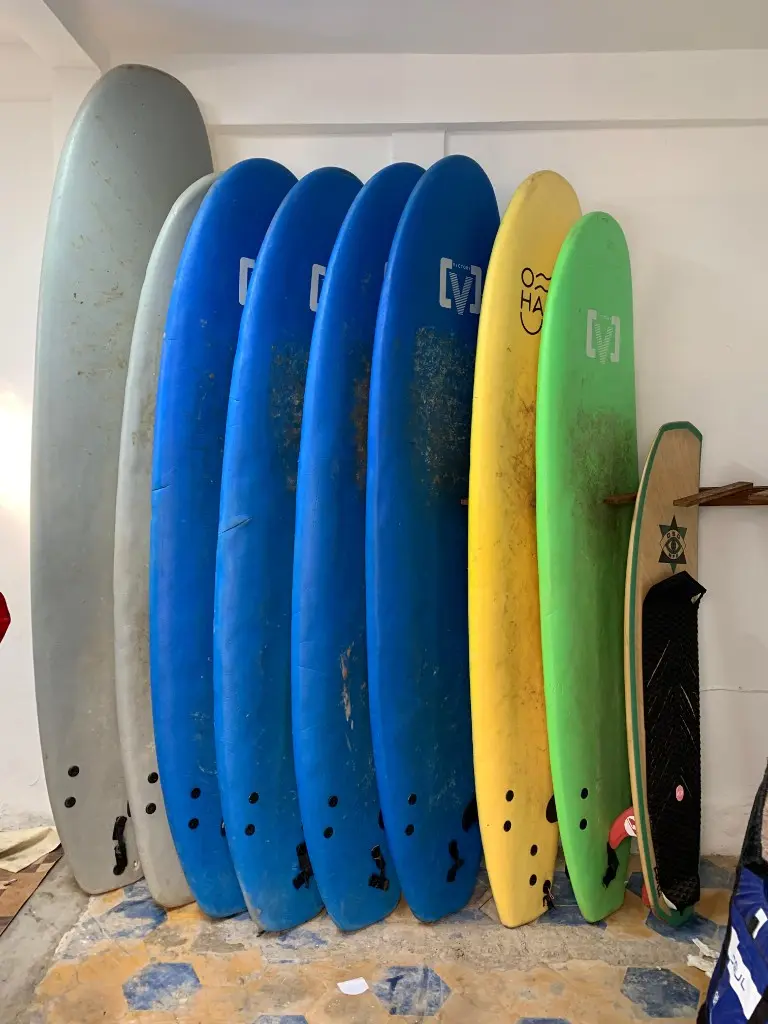
Beginner tip: do not change fins on school foam boards — they are fixed or standard. Interest in fins starts when buying a funboard or shortboard.
Choosing Surf Fin Size
FCS Size System (Market Reference)
| FCS size | Surfer weight | Typical use |
|---|---|---|
| XS | < 55 kg | Groms, boards < 6'0 |
| S | 55–70 kg | Shortboard 5'8–6'2, light |
| M | 65–80 kg | Standard daily driver |
| L | 75–90 kg | Heavy surfer, powerful waves |
| XL | 85 kg+ | Big guy, step-up |
Factors Beyond Weight
- Board size: 9'0 longboard → 9" single fin; 6'0 short → S or M thruster
- Conditions: powerful swell → larger fins (more hold); small waves → smaller fins (more slide)
- Level: beginner/inter → medium, flexible flex; advanced → size down, stiff flex for reactivity
- Style: power surfer → larger fins; aerial / skate → smaller, looser
Practical Thruster Rule
- Mellow waves, wide board: M fins, flexible flex (e.g. FCS II Performer PC)
- Hollow waves, shortboard: M or L, stiff flex (e.g. FCS II Accelerator)
- Beginner funboard: L flexible fins — maximum stability
Fin Materials and Flex
Common Materials
| Material | Flex | Performance | Price |
|---|---|---|---|
| Plastic | Flexible | Entry level, durable | €15–30/fin |
| Fiberglass (FG) | Medium | Classic, balanced | €40–70/fin |
| Performance Core (PC) | Variable | Light, reactive | €60–100/fin |
| Carbon / Carbon Flash | Stiff | Pro, maximum drive | €80–120/fin |
| Honeycomb | Light stiff | High performance | €90–130/fin |
Impact of Flex
- Flexible flex: forgives mistakes, less grip in big waves — ideal beginner/inter
- Medium flex: versatile daily driver
- Stiff flex: instant reactivity, demands technique — advanced
Best Fins by Use in 2026
Beginner / Funboard Fins (Flexible M Thruster)
- FCS II Performer PC Tri-Fin — versatile, forgiving
- Futures F6 Alpha — solid entry level
- Shapers FCS M Core Flex — school value for money
All-Round Shortboard Fins (M Thruster)
- FCS II AM (Al Merrick) PC — reference for 20 years
- Futures F4 Thermotech — balanced
- NVS Icons — popular in California
Small Wave / Fish Fins (Twin or Quad)
- FCS II Modern Twin + 1 — versatile 2+1
- Captain Fin Co. Twin — retro style
- Futures F4 Quad Reactor — maximum speed
Longboard Single Fins
- True Ames 9" Pivot — classic noseriding
- FCS II Connect GL — performance longboard
- Captain Fin 9.5" Slasher — style
Fin Setup and Board Types
| Board type | Recommended setup | Fin size |
|---|---|---|
| Beginner foam 8'0 | Fixed thruster (plastic) | Included, not modifiable |
| Funboard 7'6 | Flexible M thruster | FCS II M or Futures F6 |
| Fish 5'10 | Twin or quad | S–M by weight |
| Shortboard 6'1 | M–L thruster | By conditions |
| Longboard 9'6 | Single 9" | Pivot or D fin |
| Hybrid 6'4 | Thruster or quad | M performance |
Impact of Fins on Manoeuvres
Trim (Straight Line)
Larger fins = more stable trajectory, less lateral drift.
Bottom Turn
Drive from side + centre fins. Stiff fins accelerate out of turn; flexible fins slide more.
Cutback
Rail hold — fins too small = involuntary slide; too large = lack of reactivity.
Snap / Top Turn
Fin release at end of manoeuvre. Twin and quad facilitate slide; thruster controls better.
Noseriding (Longboard)
Large single fin with forward pivot point — hold on nose, release on tail.
Fin Care and Replacement
- Rinse after each session (sand in boxes = wear)
- Check screws — firm tightening without forcing (FCS II: intact clip)
- Inspect cracks on base — broken fin in session = danger
- Replace if abnormal flex, base crack, or screw corrosion
- Transport: protect fins (caps) or unscrew for bags
Lifespan: 2–5 years depending on use and material. Entry-level plastic: 1–2 years intensive.
Common Surf Fin Mistakes
- Buying pro stiff fins as a beginner — lack of hold, frustration
- Mixing FCS and Futures without checking boxes
- Fins too small for your weight — uncontrollable "loose" board
- Ignoring setup — quad on thruster-designed board without adapting
- Forgetting to screw after change — lost fin in session (classic)
- Neglecting box cleaning — stuck fins, corrosion
Fins and Conditions in Essaouira
In the bay of Essaouira:
- Morning, waves 0.5–1 m: flexible M thruster on funboard — stability and easy turns
- Winter swell 1.5 m: switch to L or stiffer fins for hold
- Sidi Kaouki: performance thruster setup, fins by day's power
School foam boards use fixed plastic fins — sufficient for whitewater. From funboard onward, optimise your setup.
FAQ
Related Posts
Watersports Guide: Surf, Kitesurf & Wing Foil Lessons in Essaouira 2026
Complete Essaouira watersports guide — surf mornings, kite & wing afternoons, IKO/ISA lesson pathways, official prices from €30, seasonal calendar and what to pack for lessons.
Packing List for a 6-Day Surf Camp in Essaouira 2026 | Complete Checklist
What to pack for a 6-day surf camp in Essaouira — wetsuit extras, layering for Atlantic wind, toiletries, electronics and MAD cash tips for Morocco's Wind City.
Guide to Surf Courses in Essaouira 2026 | Formats, Prices & Spots
Complete guide to surf courses in Essaouira — group, semi-private and private lessons from €30, multi-day packs, ISA coaching, lesson roadmap, Sidi Kaouki safaris and booking tips.
Surf Reviews — Essaouira Surf Camp School
Real surf guest experiences in Essaouira, Morocco — IKO & ISA certified school, 5/5 Google rating.
Surf FAQ Essaouira — Questions & Answers
Everything about surf in Essaouira: prices, levels, gear, weather, booking and Morocco spots.